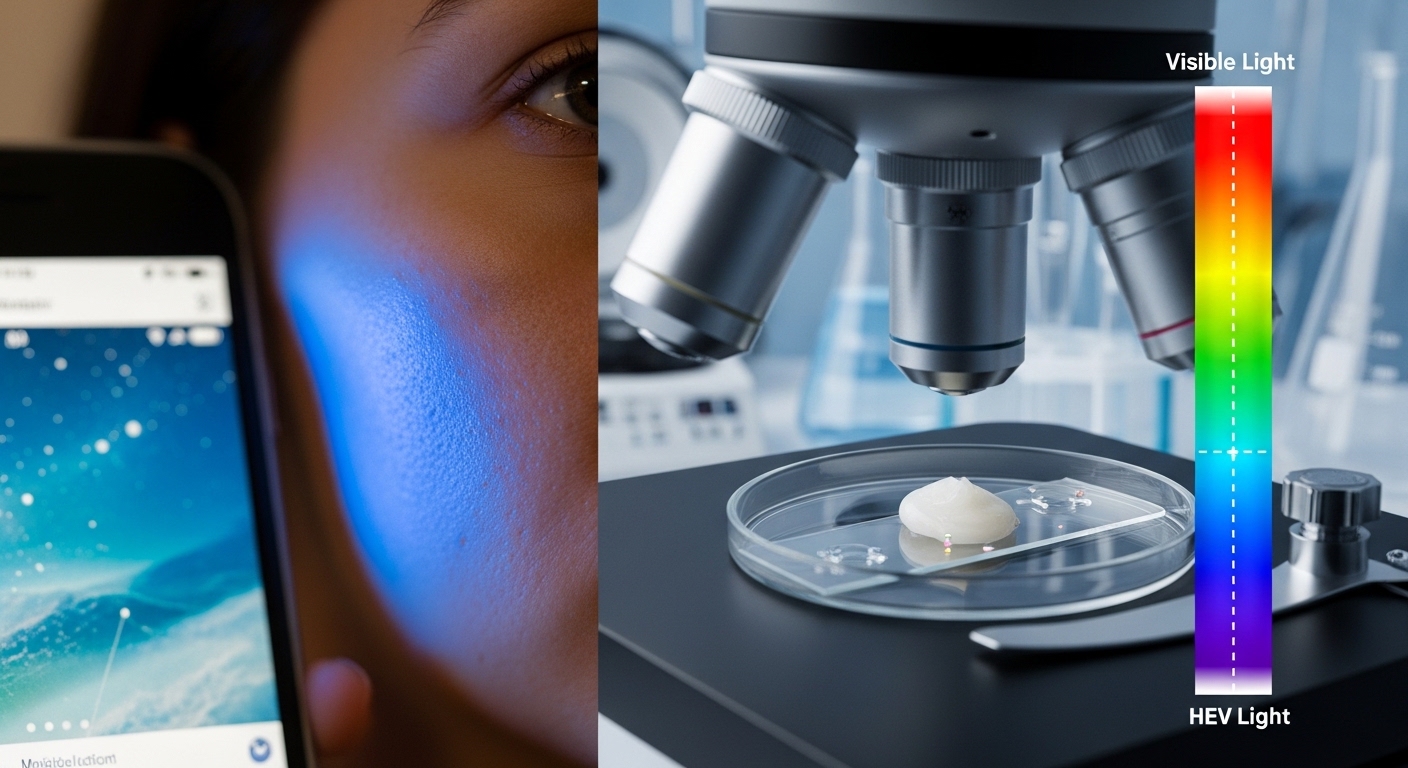
The skincare industry's latest frontier involves defending against an invisible enemy: high-energy visible (HEV) blue light emitted from digital screens, LEDs, and sunlight. Market analysts project the blue light protection skincare market to reach $1.8 billion by 2027, growing at 7.3% annually. However, dermatological research presents a more nuanced picture about whether these products offer genuine protection or capitalize on digital anxiety.
Understanding HEV Light: Physics Meets Biology
Blue light occupies the 400-495 nanometer range on the visible spectrum, with HEV light specifically referring to wavelengths between 400-450nm. Unlike UV radiation, blue light penetrates deeper into the skin, reaching the dermis where collagen and elastin fibers reside. The concern stems from photochemical rather than thermal effects—blue light generates reactive oxygen species (ROS) through excitation of endogenous photosensitizers like flavins and porphyrins.
A 2023 study in the Journal of Investigative Dermatology exposed human skin explants to blue light at intensities mimicking 8 hours of screen exposure. Researchers observed a 23% increase in matrix metalloproteinase-1 (MMP-1) expression, an enzyme that degrades collagen. However, critical context emerges: the study used concentrated blue light without the full visible spectrum, and actual device emissions are 100-1,000 times less intense than study conditions.
"Blue light from screens is approximately 0.5-1% as intense as midday sunlight. The dose makes the poison, and current evidence suggests incidental screen exposure represents minimal risk compared to cumulative sun exposure." – Dr. Anjali Mahto, Consultant Dermatologist
The Ingredient Analysis: What Actually Works?
Iron Oxides: Physical Barrier or Marketing Claim?
Many tinted sunscreens and "screen protection" products contain iron oxides, primarily red, yellow, and black varieties. Research from the University of São Paulo demonstrates that iron oxides absorb specific blue light wavelengths between 400-420nm. In vitro studies show 85-92% absorption in this narrow band, creating a legitimate physical barrier.
However, practical application reveals limitations. The 2024 International Journal of Cosmetic Science published a double-blind study comparing iron oxide-containing formulations against pure blue light sources. While products reduced immediate ROS generation by 67%, protection dropped to 22% after 4 hours due to product breakdown and skin absorption. Furthermore, most consumer devices emit broader blue spectra (up to 495nm) where iron oxide absorption decreases significantly.
Antioxidant Cocktails: Prevention vs. Protection
The antioxidant approach represents the dominant strategy in blue light skincare. Ingredients like vitamin C (L-ascorbic acid), vitamin E (tocopherol), ferulic acid, and niacinamide don't block blue light but neutralize the ROS generated by it. A Baylor College of Medicine study quantified this effect: a combination of 15% L-ascorbic acid, 1% vitamin E, and 0.5% ferulic acid reduced blue light-induced oxidative stress by 78% in cultured fibroblasts.
The distinction between prevention and protection becomes crucial here. Antioxidants repair damage already occurring rather than preventing light penetration. Their efficacy depends entirely on concentration, formulation stability, and skin penetration—variables poorly regulated in cosmetic claims. Independent laboratory testing by Consumer Reports found that 40% of blue light protection products contained antioxidant concentrations below scientifically established effective thresholds.
Novel Ingredients: Carotenoids and Beyond
Emerging research focuses on carotenoids, particularly lutein and zeaxanthin, which naturally filter blue light in the human retina. Topical applications show promise but face significant challenges. A German dermatology study found that 0.1% lutein serum reduced blue light-induced inflammation markers by 41%, but the ingredient's instability in cosmetic formulations limited shelf life to 3 months under optimal conditions.
More experimental approaches include melanin-inspired polymers and quantum dot technologies that selectively absorb specific wavelengths. While promising in laboratory settings, these remain years from commercial viability due to safety testing requirements and manufacturing complexities.
Device Emissions: Quantifying Actual Exposure
The fundamental question often overlooked: how much blue light actually reaches skin from typical device use? Measurements conducted by the Lighting Research Center at Rensselaer Polytechnic Institute provide revealing data:
- Smartphone at maximum brightness: 15-40 lux at typical viewing distance
- Computer monitor: 20-100 lux
- LED room lighting: 50-500 lux
- Daylight (shaded): 10,000-25,000 lux
More telling is spectral power distribution analysis. Modern devices with "eye comfort" or "night mode" settings reduce blue light emissions by 30-70% through software filtering. Apple's True Tone technology, for instance, dynamically adjusts white balance based on ambient light, reducing blue peaks during evening use. The actual irradiance reaching facial skin during normal computer use measures 0.03-0.08 mW/cm², compared to 2-4 mW/cm² from indirect daylight.
Comparative Risk Assessment: Blue Light vs. Established Threats
Dermatological risk assessment requires proportional perspective. The British Association of Dermatologists' 2025 position paper quantified comparative damage potential:
For collagen degradation per hour of exposure: - UVA radiation: 100 arbitrary units - UVB radiation: 85 arbitrary units - HEV blue light (sunlight): 15 arbitrary units - HEV blue light (devices): 0.3-0.8 arbitrary units
The paper concludes that 60 minutes of unprotected sun exposure causes approximately 150 times more collagen damage than 8 hours of screen use. This doesn't dismiss blue light concerns entirely but contextualizes them within established skincare priorities.
Evidence-Based Recommendations
Who Actually Needs Specialized Protection?
Clinical evidence supports targeted blue light protection for specific populations:
Post-Procedure Patients: Those undergoing laser treatments, chemical peels, or taking photosensitizing medications (certain antibiotics, retinoids) demonstrate increased sensitivity. A University of California study found blue light exacerbated inflammation in 73% of patients during the first week after fractional laser treatment.
Melasma and Hyperpigmentation-Prone Skin: Research in the Journal of Cosmetic Dermatology shows blue light can stimulate melanogenesis through OPN3 receptor activation. Patients with melasma showed 34% less pigmentation recurrence when using iron oxide-containing sunscreen versus chemical-only formulations.
Extreme Digital Exposure: Gamers, video editors, and professionals spending 12+ hours daily before multiple high-intensity screens may benefit from preventive measures, though lifestyle modifications (distance, breaks, screen filters) offer more significant protection than topical products alone.
The Hierarchy of Effective Protection
Based on current evidence, effectiveness prioritizes:
- Physical Barriers: Tinted sunscreens with iron oxides (SPF 30+) provide the most reliable broad-spectrum protection when formulation includes adequate iron oxide concentration (minimum 3% total).
- Antioxidant Reinforcement: Evidence-supported concentrations: 10-20% vitamin C, 2-5% niacinamide, 0.5-1% vitamin E applied before potential exposure.
- Device Modifications: Software blue light filters, matte screen protectors, and increased viewing distance (arm's length reduces intensity by approximately 60%).
- Environmental Adjustments: Ambient lighting matching screen brightness reduces pupil dilation and potential light penetration.
Regulatory Landscape and Consumer Protection
The lack of standardized testing protocols for blue light protection represents a significant regulatory gap. Unlike SPF (FDA) and UVA protection (PA/PPD systems), no universally accepted measurement exists for HEV protection. Companies utilize various in vitro methods with different light sources, intensities, and endpoints, making direct comparison impossible.
The European Commission's Scientific Committee on Consumer Safety recently proposed a testing framework using standardized LED arrays and specific ROS measurement protocols. Until adoption, consumers face a marketplace where "blue light protection" can mean anything from legitimate science to marketing hyperbole.
Future Research Directions
Longitudinal studies tracking actual device users represent the most needed research. Current evidence relies heavily on artificial exposure conditions that don't replicate real-world usage patterns, cumulative effects, or individual variations in screen habits and skin physiology.
Emerging areas include personalized protection based on individual screen time analytics and skin sensor technologies that measure actual light exposure. Several research groups are developing wearable dosimeters that quantify personal HEV exposure, potentially revolutionizing evidence-based recommendations.
The most promising developments come from display technology itself. Samsung's 2024 OLED panels incorporate organic materials that emit less energetic blue wavelengths while maintaining color accuracy. Such technological solutions at the source may eventually make topical protection largely unnecessary for digital device exposure.
Blue light protection skincare exists at the intersection of legitimate science and marketing opportunity. While HEV light can theoretically damage skin, the actual risk from typical screen use appears minimal compared to established threats like UV exposure and pollution. For most consumers, a broad-spectrum sunscreen with iron oxides provides adequate incidental protection, while evidence-supported antioxidants offer additional security. The most effective strategy combines reasonable topical protection with practical device adjustments, focusing resources on skincare concerns with stronger scientific substantiation.