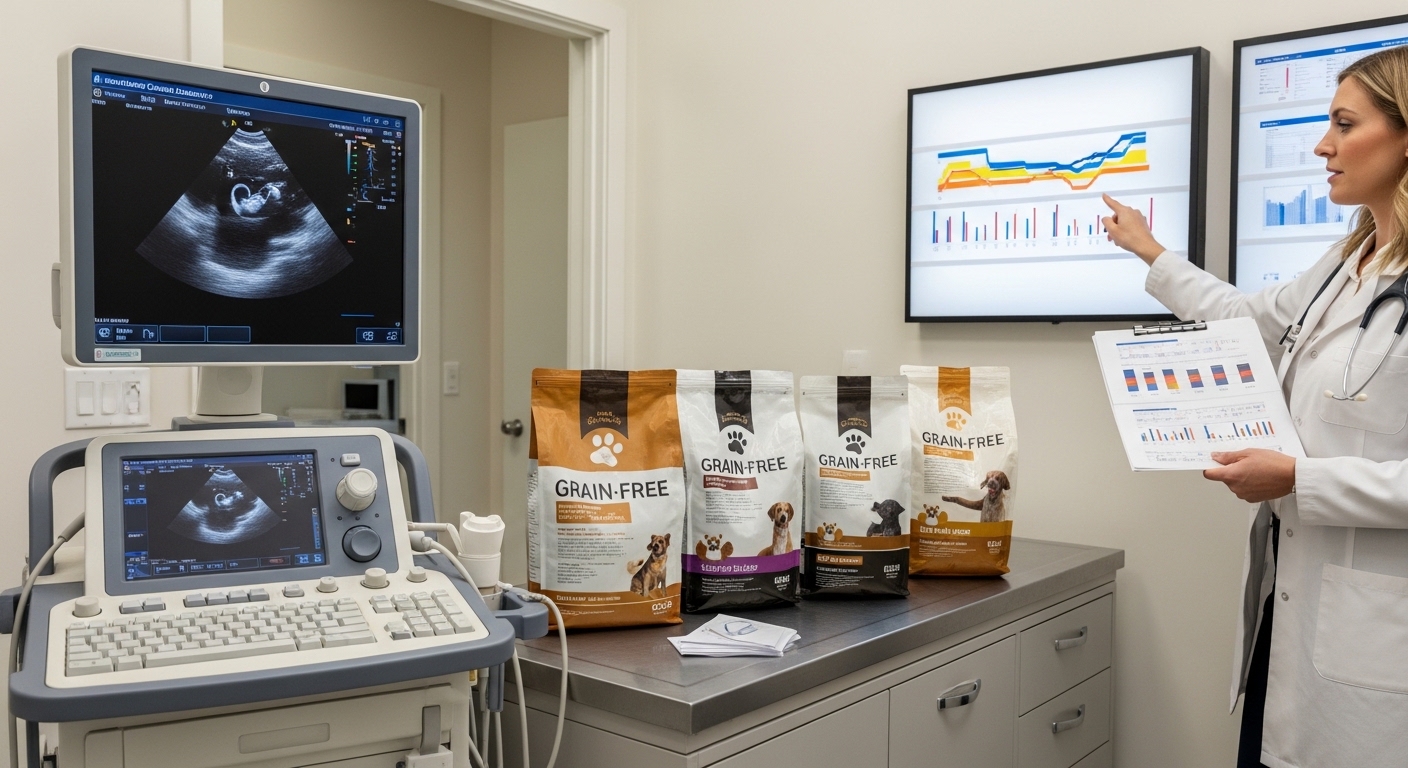
The relationship between grain-free dog foods and dilated cardiomyopathy represents one of veterinary medicine's most significant nutritional discoveries of the past decade. What began as anecdotal reports in 2017 has evolved into comprehensive research involving over 1,100 confirmed cases, revealing unexpected connections between popular dietary trends and potentially fatal heart conditions in dogs previously considered low-risk for cardiac disease.
The DCM Epidemic: Patterns Defying Genetic Expectations
Dilated cardiomyopathy is a myocardial disease characterized by chamber dilation and systolic dysfunction. Traditionally considered a genetic condition predominantly affecting specific breeds like Doberman Pinschers, Great Danes, and Irish Wolfhounds, veterinary cardiologists began noticing alarming patterns starting in 2014. Golden Retrievers, Labrador Retrievers, Miniature Schnauzers, and mixed-breed dogs—breeds with historically low DCM incidence—were presenting with echocardiographic findings identical to genetic DCM.
The University of California, Davis Cardiology Service documented the shift quantitatively. Between 2000-2010, only 2.3% of DCM cases involved "unexpected breeds." From 2014-2019, that percentage skyrocketed to 47.8%. More striking was dietary commonality: 93% of these atypical cases consumed grain-free diets for at least six months prior to diagnosis, compared to 12% of genetic DCM cases eating similar diets.
"We're not seeing traditional malnutrition. We're seeing a nutritional imbalance in apparently high-quality foods that's altering cardiac metabolism in ways we're just beginning to understand." – Dr. Joshua Stern, Veterinary Cardiologist, UC Davis
The FDA Investigation: From Correlation to Causation
The U.S. Food and Drug Administration's Center for Veterinary Medicine launched its investigation in 2018 after receiving 524 reports of DCM in dogs eating grain-free diets. By 2024, the agency had documented 1,382 cases with 286 deaths. While acknowledging this represents reporting bias rather than true incidence, the statistical significance compelled deeper analysis.
FDA researchers identified several consistent patterns: - 91% of reported foods were grain-free - 93% contained peas and/or lentils - 87% contained potatoes or sweet potatoes - 42% contained multiple pulse ingredients (peas, lentils, chickpeas, beans)
The agency's 2023 follow-up study analyzed 150 implicated diets against 150 control diets. Implicated foods averaged 32% protein content versus 26% in controls, with the additional protein primarily coming from pulse legumes rather than animal sources. More significantly, the amino acid profiles showed notable differences in taurine, cysteine, and methionine ratios—all critical for cardiac health.
Pulse Legumes: The Suspected Mechanism
The current leading hypothesis centers on pulse legumes interfering with taurine synthesis and utilization. Unlike cats, dogs can synthesize taurine from precursor amino acids cysteine and methionine. However, this pathway appears disrupted by certain legume compounds.
Research from Tufts University's Cummings School of Veterinary Medicine identified several potential mechanisms:
Bioavailability Reduction
Phytic acid and tannins abundant in pulses bind to minerals (zinc, iron) and amino acids, reducing their absorption. A 2022 study found dogs fed high-pulse diets absorbed 34% less cysteine and 28% less methionine than controls.
Fiber Interference
Soluble fibers in legumes increase fecal bile acid excretion, forcing the liver to use taurine for bile acid conjugation. Dogs on pulse-rich diets excreted 41% more taurine in feces.
Gut Microbiome Alteration
Certain legume carbohydrates promote bacteria that degrade taurine. Metagenomic analysis revealed increased sulfite-reducing bacteria in dogs eating grain-free diets.
Breed-Specific Sensitivities
Not all dogs respond equally to pulse-rich diets. Golden Retrievers demonstrate particular vulnerability, comprising 28% of diet-associated DCM cases despite representing only 6% of the dog population. Genetic studies identified variations in the TAU gene affecting taurine transporter efficiency.
The American College of Veterinary Internal Medicine's 2024 guidelines categorize risk levels:
- High Risk: Golden Retrievers, Labrador Retrievers, Miniature Schnauzers, Mixed breeds over 50 lbs
- Moderate Risk: Dobermans, Great Danes, Cocker Spaniels eating grain-free diets alongside genetic predisposition
- Lower Risk: Small breeds under 20 lbs, though cases have been reported
Diagnostic Challenges
Diet-associated DCM presents differently than genetic forms. Echocardiography reveals similar structural changes but with distinct biochemical markers. Blood taurine levels below 40 nmol/mL (normal: 60-120) strongly suggest diet association, yet 23% of cases have normal taurine levels, indicating alternative mechanisms.
Cardiac biomarker NT-proBNP shows elevation earlier in diet-associated cases. A University of Minnesota study found NT-proBNP > 900 pmol/L in 78% of diet-associated DCM cases versus 45% of genetic cases at diagnosis.
Reversal Potential: The Hopeful Data
Unlike genetic DCM, diet-associated cases often show significant improvement with intervention. A multicenter study tracking 243 dogs found:
- 87% showed echocardiographic improvement within 3 months of diet change
- 62% normalized cardiac dimensions within 6 months
- Mortality rate: 11% versus 68% for genetic DCM over 24 months
The standard protocol involves: 1. Immediate diet change to grain-inclusive, pulse-limited formulation 2. Taurine supplementation (500-1000 mg twice daily) 3. Cardiac medications as needed (pimobendan, ACE inhibitors) 4. Serial echocardiography every 3 months
Evaluating Pet Foods Beyond Marketing
Veterinary nutritionists recommend assessing foods by formulation rather than claims:
Red Flags
- Multiple pulse ingredients in top 5 components - Potatoes/sweet potatoes as primary carbohydrates - "Exotic" protein sources without research backing - "Grain-free" as primary marketing focus
Preferable Formulations
- Whole grains (rice, oats, barley) in carbohydrate mix - Animal proteins as first ingredients - Limited pulse inclusion (below 10% total) - AAFCO feeding trial statement rather than formulation claim
Industry Response and Regulation Gaps
The pet food industry has responded variably. Some manufacturers have reformulated products, while others emphasize that no regulatory changes mandate reformulation. The Association of American Feed Control Officials has proposed but not implemented guidelines for pulse inclusion limits.
Critical gaps remain in pet food regulation: - No requirement for amino acid profile disclosure - No taurine content labeling requirements - "Complete and balanced" claims based on formulation, not feeding trials for many products
Practical Recommendations for Pet Owners
Based on current evidence, veterinary cardiologists suggest:
- Diet Diversity: Rotate between 2-3 different high-quality foods to mitigate any single formulation's risks
- Regular Screening: Annual echocardiography for high-risk breeds on grain-free diets
- Blood Monitoring: Annual taurine and NT-proBNP testing for dogs on pulse-rich diets
- Informed Choices: Consult veterinary nutritionists for dietary planning rather than relying on marketing
The grain-free and DCM connection highlights how well-intentioned dietary trends can have unintended consequences. While not all grain-free diets cause DCM, and not all dogs are equally susceptible, the evidence strongly suggests pulse-heavy formulations pose cardiac risks for many dogs. Ongoing research continues to refine our understanding, but current data supports cautious evaluation of grain-free diets and proactive monitoring for dogs consuming them.