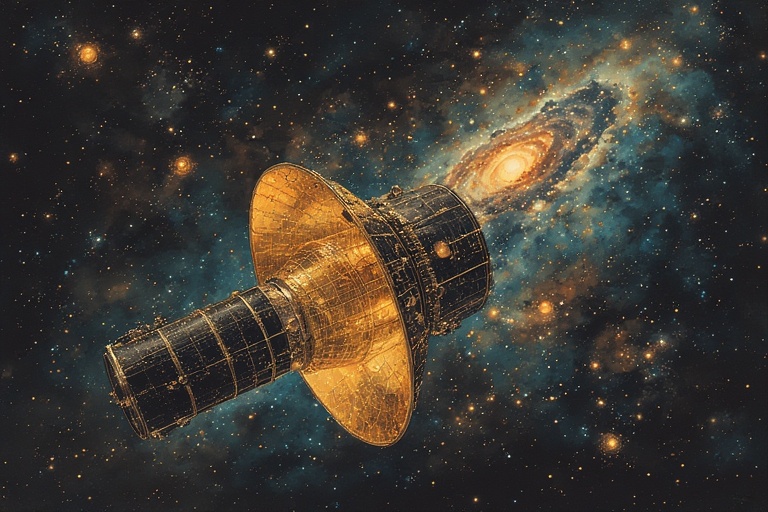
There is a profound and ancient connection between the stars and ourselves, a story written not in words, but in atoms. For decades, scientists have theorized that the fundamental ingredients for life—the complex carbon-based molecules that form our very cells—were forged in the nuclear furnaces of stars and scattered across the cosmos. Now, NASA's James Webb Space Telescope (JWST) has delivered stunning, tangible evidence that not only confirms this, but dramatically rewrites the timeline. In the cold, tenuous depths of space, in a galaxy so distant we see it as it was billions of years ago, Webb has detected the unmistakable signature of large, complex organic molecules, the very building blocks of life as we know it.
"We are not just living in the universe; the universe is living within us. This discovery doesn't just show us where we came from—it suggests that the recipe for life is a fundamental part of cosmic evolution."
This isn't about finding little green microbes. This is about finding the cosmic flour and sugar before the cake is even mixed. The molecules detected, known as polycyclic aromatic hydrocarbons (PAHs), are intricate, carbon-based structures. Finding them in such an early galaxy indicates that the universe got down to the serious business of creating life's prerequisites much faster, and in much more hostile environments, than anyone had dared to predict. It suggests that the universe might be inherently bio-friendly, pre-loaded with the necessary components for biology to eventually spark.
The Discovery: Reading the Chemical Fingerprints of the Infant Cosmos
The power of the James Webb Telescope lies in its unparalleled ability to dissect infrared light. As the universe expands, light from its most distant objects is stretched into the infrared part of the spectrum, a realm invisible to human eyes and poorly observed by previous telescopes like Hubble. Webb is essentially a time machine, peering back to an era when the first galaxies were still assembling themselves.
In one such infant galaxy, astronomers pointed Webb's sensitive instruments and saw something extraordinary. By analyzing the specific wavelengths of light absorbed by the gas and dust in this galaxy, they found the chemical "fingerprint" of large, complex carbon molecules. It's a bit like analyzing the smoke from a distant fire and determining not just that wood is burning, but the specific type of tree. The presence of these molecules in such a young galaxy implies that the chemical pathways to complexity were already well underway when the universe was only a fraction of its current age.
The Implications: A Universe Ripe for Life
This discovery shatters previous assumptions about the conditions necessary to form these biological precursors. Scientists believed that such complex molecules required the relatively calm, enriched environments of mature galaxies like our own Milky Way, where generations of stars had already lived and died, seeding space with heavy elements.
Finding them in the early universe suggests a far more efficient and universal process. It implies that the emergence of complex chemistry is not a rare, lucky accident, but a standard part of galactic evolution. This has a direct impact on the search for life beyond Earth. If these building blocks are ubiquitous, scattered across the cosmos from the very beginning, then the potential for life to arise on other worlds—exoplanets orbiting distant stars—becomes exponentially more likely. We are not special in our ingredients; we are special in what we've managed to bake with them.
A Scientific Parallel: From Primordial Soup to Cosmic Kitchen
This discovery provides a cosmic-scale parallel to the famous Miller-Urey experiment of the last century. In that groundbreaking work, scientists simulated the conditions of early Earth, combining simple gases like methane and ammonia with electrical sparks to simulate lightning. The result was the spontaneous formation of amino acids, the building blocks of proteins.
Webb's finding is the astronomical equivalent. It shows us that the universe itself is conducting a vast, ongoing Miller-Urey experiment. Instead of a flask in a lab, the laboratory is entire nebulas. Instead of electrical sparks, the energy comes from intense starlight and shockwaves from supernovae. The output is not just amino acids, but a whole suite of complex organic molecules, ready to be delivered to newborn planets by comets and asteroids. The experiment has been running for billions of years, across countless galaxies.
| Cosmic Era | Previous Understanding | Webb Telescope's New Insight |
|---|---|---|
| Early Universe | Only simple molecules like hydrogen and carbon monoxide could form. | Complex carbon molecules (PAHs) formed rapidly in infant galaxies. |
| Planet Formation | Planets formed from simple ices and dust; complex chemistry came later. | New planets were likely seeded from the start with life's building blocks. |
| Potential for Life | Life's ingredients might be rare, requiring specific galactic conditions. | The universe appears to be a prolific factory for organic chemistry, boosting the odds of life elsewhere. |
The Future: Redefining Our Place in the Cosmos
This is more than a single data point; it's a fundamental shift in perspective. Every time we build a tool that allows us to see the universe more clearly, we are humbled to discover that it is both more vast and more intimate than we imagined. The James Webb Space Telescope is showing us that the line between astronomy and biology is far blurrier than we thought.
The next steps are clear. Astronomers will now use Webb to conduct a census of these complex molecules across different galaxies and cosmic epochs. They will search for them in the protoplanetary disks around young stars—the very nurseries where new worlds are born. Each observation will add another piece to the puzzle of how non-living matter assembles itself into the intricate structures we recognize as life.
We are living in a golden age of cosmic discovery. With every new observation, the universe reveals itself not as a cold, empty void, but as a dynamic, chemical-rich environment, seemingly fine-tuned for the emergence of complexity. The discovery of life's building blocks in the early universe is a powerful reminder that we are not isolated beings on a lonely rock, but an integral part of a grand, ongoing cosmic narrative—one that is just beginning to be read.