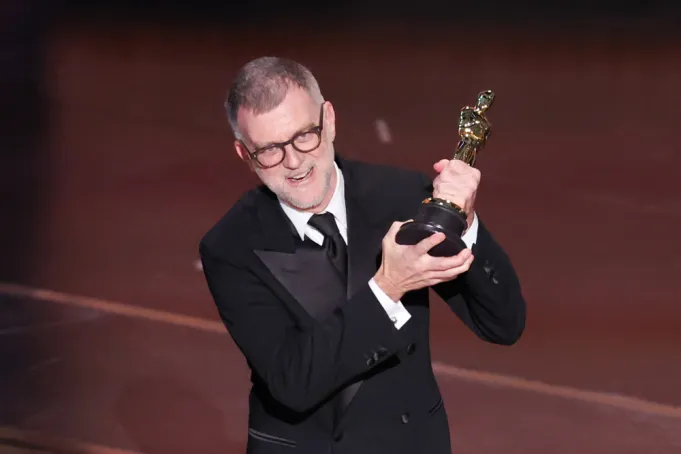
After 11 career nominations spanning three decades, Paul Thomas Anderson finally took home the Best Director Oscar at the 2026 Academy Awards for his epic crime drama "One Battle After Another." The win marked a historic moment for one of American cinema's most celebrated filmmakers who had never before won a competitive Oscar despite critical acclaim and a devoted following.
Anderson, 56, accepted the award from presenters at the Dolby Theatre in Hollywood, delivering a characteristically humble and heartfelt speech that acknowledged both his collaborators and the long journey to this recognition.
"You make a guy work hard for one of these. I really appreciate it." — Paul Thomas Anderson
He faced stiff competition in the Best Director category, nominated alongside Chloé Zhao ("Hamnet"), Josh Safdie ("Marty Supreme"), Ryan Coogler ("Sinners"), and Joachim Trier ("Sentimental Value"). His victory was widely celebrated as a long-overdue recognition from the Academy.
A Night of Firsts and Long-Awaited Recognition
Anderson's Oscar win was actually threefold. In addition to Best Director, he also took home awards for Best Adapted Screenplay and, as a producer, Best Picture—all for "One Battle After Another." It was his first competitive Oscar win in any category after 11 previous nominations for films including "Boogie Nights," "There Will Be Blood," "The Master," and "Phantom Thread."
"One Battle After Another" emerged as one of the night's biggest winners with 13 total nominations across categories. The film stars Leonardo DiCaprio in a career-defining performance that earned him a Best Actor nomination. Supporting players Benicio del Toro and Sean Penn both received nods for Best Supporting Actor, while Teyana Taylor earned recognition in the Best Supporting Actress category.
The film's massive Oscar haul reflected the industry's embrace of Anderson's ambitious storytelling. Described as a politically charged road movie with elements of thriller and dark comedy, "One Battle After Another" represented Anderson's largest-scale production to date.
Emotional Dedication to Adam Somner
The emotional core of Anderson's awards season run has been his dedication to Adam Somner, his longtime producer and assistant director who passed away during the film's production. Anderson referenced Somner in both his BAFTA acceptance speech and again at the Oscars.
"I share this with a friend of mine on the other side of the shadows. His name is Adam and he is having a gin and tonic and is so happy for me and our crew," Anderson said during his Oscar acceptance.
Earlier in the awards season, while accepting the BAFTA Film Award for Best Director, Anderson offered more detail about Somner's final days working on the film. "About three weeks into our film, he found out he was sick, and he made it through production," Anderson shared. "If you've ever gone to work before with someone who's very ill, there's something miraculous that makes you pay attention and reminds you the privilege of the work that we do."
Somner had worked with Anderson for nearly two decades, serving as assistant director on films including "There Will Be Blood," "The Master," and "Phantom Thread." His death during production of "One Battle After Another" deeply affected the cast and crew, and Anderson has consistently framed his awards as a tribute to his late collaborator.
A Competitive Director Field
Anderson's win came in a remarkably strong year for directing nominations. Chloé Zhao, who previously won Best Director for "Nomadland," returned with "Hamnet," a Shakespearean drama that earned critical praise. Josh Safdie, nominated for "Marty Supreme," represented one half of the Safdie brothers directing team, earning his first solo nomination. Ryan Coogler's "Sinners" marked his return to original filmmaking after the "Black Panther" franchise. Joachim Trier's "Sentimental Value" continued his exploration of Norwegian family dynamics.
Anderson acknowledged his fellow nominees in his speech, saying, "My classmates: Chloé, Ryan, Joachim and Josh, I couldn't ask for a better class. It's an honor to be counted amongst you guys."
The camaraderie among the nominees reflected a broader trend in this year's awards season, where established auteurs were celebrated alongside emerging voices.
Anderson's Long Road to Oscar Gold
The director's path to his first Oscar win is one of the more notable stories in recent Academy history. Anderson earned his first nomination for Best Original Screenplay for "Boogie Nights" in 1998. His 2008 film "There Will Be Blood" earned him nominations for Best Director and Best Adapted Screenplay, with the film winning Best Actor for Daniel Day-Lewis but leaving Anderson empty-handed.
Subsequent nominations came for "The Master" (2013), "Phantom Thread" (2018), and "Licorice Pizza" (2022), all of which garnered critical acclaim but no wins for Anderson personally. The 2026 ceremony marked his 11th, 12th, and 13th nominations across three categories, finally resulting in his first competitive victory.
"There will always be some doubt in your heart that you deserve it, but there is no question at the pleasure having it for myself," Anderson admitted in his speech, capturing the mix of humility and joy that defined his awards season demeanor.
What "One Battle After Another" Means for Anderson's Legacy
For cinephiles who have followed Anderson's career since his 1996 debut "Hard Eight," the Oscar wins represent not just recognition for one film but an endorsement of his entire body of work. "One Battle After Another" arrives at a moment when Anderson's influence on American independent cinema is already secure, but the Oscar wins cement his place in the Hollywood establishment.
The film itself continues Anderson's exploration of complicated masculinity, systemic corruption, and the search for redemption—themes that have defined his work for three decades. With a reported budget exceeding $100 million, it represents his most expensive production and a major studio investment in a director known for idiosyncratic storytelling.
Initial critical response praised Anderson's ability to balance epic scale with intimate character work, suggesting that his filmmaking instincts remain sharp even as his budgets have grown. The film's 13 Oscar nominations reflected broad Academy support across technical and artistic categories.
Reactions from Hollywood
Social media erupted with congratulations following Anderson's win. Former collaborators including Daniel Day-Lewis, Philip Seymour Hoffman's family (who appeared in several Anderson films), and a generation of younger filmmakers influenced by his work all expressed excitement at the long-awaited recognition.
Martin Scorsese, himself a longtime Anderson admirer, released a statement calling Anderson "one of the essential voices of American cinema" and noting that "his best work is always what he does next."
The film's star Leonardo DiCaprio was seen visibly emotional during Anderson's acceptance speech, having worked closely with the director to craft what many critics called his most vulnerable performance in years.
What This Means for Future Oscars
Anderson's win, coming after years of being considered overdue, may signal a shift in how the Academy approaches auteurs who work outside traditional studio systems. His career trajectory—from independent breakout to acclaimed auteur to finally Oscar-winning mainstream success—mirrors a path taken by directors like Scorsese, the Coen brothers, and Quentin Tarantino.
With his first Oscars now secured, Anderson joins an exclusive group of directors who have won multiple Academy Awards in a single night. His triple win (Picture, Director, Screenplay) places him alongside elite company in Oscar history.
For fans and critics who have long argued that Anderson deserved recognition, the 2026 ceremony finally provided vindication. As he said in his closing remarks, "I'm so happy to call the movies home. This is really terrific."
The 98th Academy Awards will be remembered as the night Paul Thomas Anderson finally took his place among Oscar-winning directors—a moment that felt, to many who have followed his career, both inevitable and deeply satisfying.