In an era where visibility is often mistaken for value, the most compelling statements are frequently those held in reserve. Consider the sartorial landscape: where does the gaze linger longest? Not always on the most exposed canvas, but often on the one that requires a second look. This is the potent alchemy of the concealed reveal—a design principle exemplified by the open-back dress. It speaks to a more sophisticated calculus of allure, one built not on proclamation, but on discovery, transforming the wearer from a passive subject into an active curator of perception.
True intrigue isn't broadcasted; it's architectured. It exists in the negative space, in the detail withheld until the moment of turned shoulder or retreating step.
The Power of the Delayed Narrative
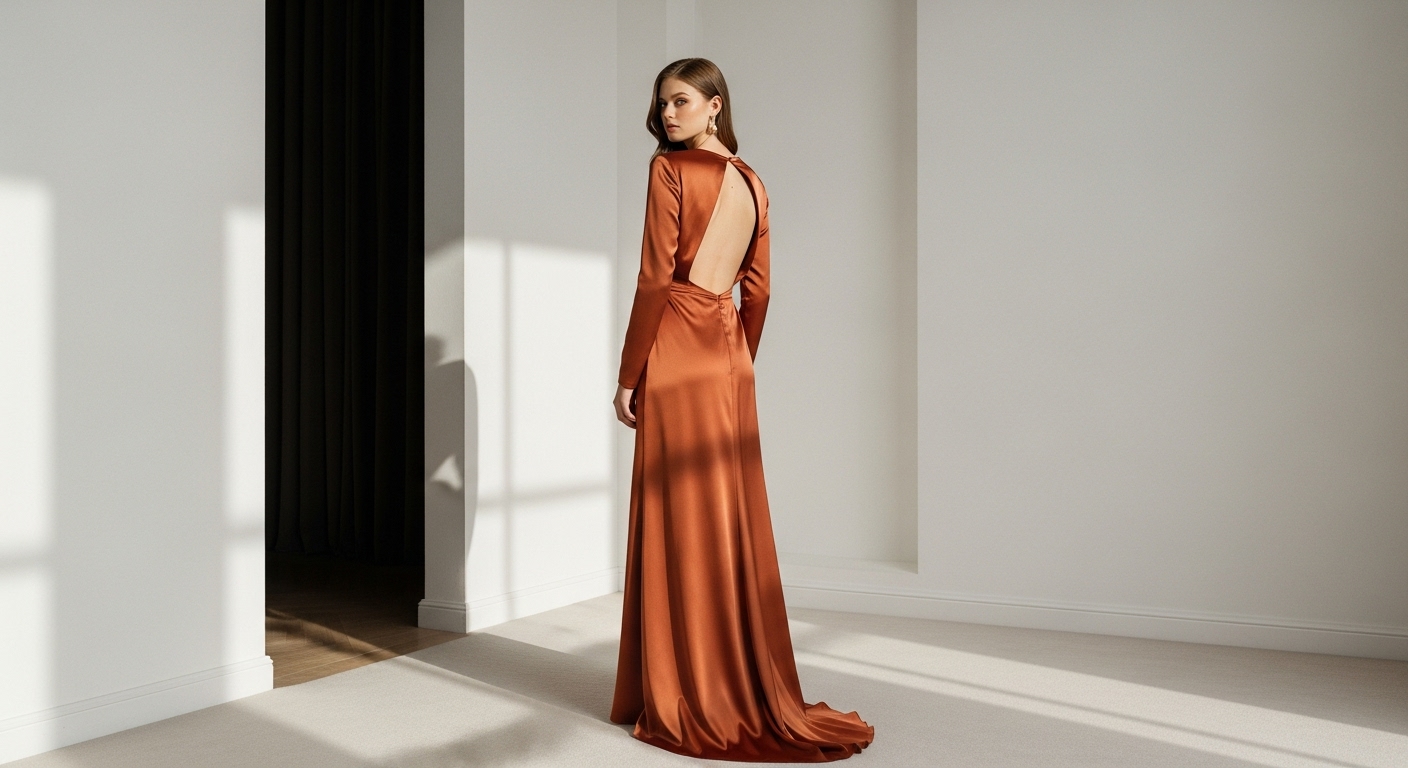
Frontal dressing offers an immediate, one-note synopsis. A deep V-neck or a mini-hemline communicates its intent in an instant. The open-back design, by contrast, authors a narrative with a deliberate pace. Its first chapter is one of refined composure: a modest neckline, a covered front, an elegant silhouette. It engages with classic codes of polish. The revelation—the architectural scoop, the delicate drape, the daring plunge traced down the spine—is saved for the second act.
This delay is everything. It creates a dynamic interaction between the wearer and the observer, built on movement and perspective. It grants the wearer control over the narrative's climax. In a room, she is not a static image to be fully apprehended at a glance; she becomes a sequence of impressions. The initial view promises elegance, but the turned profile or retreating figure delivers a crescendo of considered daring. This staged disclosure is inherently more engaging, more memorable, because it involves the viewer in a process of discovery. It commands attention through subtlety, not volume.
The Spine as a Canvas: Intimacy with Distance
There is a profound intimacy to revealing the back, a canvas traditionally associated with retreat, vulnerability, and quiet strength. To expose the spine—the architectural core of the body—feels inherently more personal and sculptural than revealing more conventional zones. It is a revelation that feels earned, not given. It creates a sense of privileged access, a secret shared with those granted a rear view. This paradox is key: it generates closeness while maintaining a literal and figurative distance. The wearer is not confronting the gaze head-on; she is allowing it, on her own terms, as she moves through her environment. This grants an aura of untouchable confidence, a power derived from selective visibility.
Curated Perception Versus Blanket Exposure
This philosophy moves us beyond the tired binary of "modest vs. sexy." It introduces a third axis: strategic. The concealed reveal is a tool of curation. It decides what part of the story to tell, and when. A dress with a severe open back and a covered front is not hiding; it is focusing. It declares that the wearer’s identity is not monolithic, but layered. She contains multitudes—the poised guest, the dramatic individual, the subtle sensualist—and she chooses which layer to present based on her orientation to the world.
Psychologically, this aligns with a modern desire for agency and complexity. In a digital age of personal branding and total exposure, controlling one's narrative is the ultimate luxury. The open-back dress is a physical metaphor for this. It allows the wearer to modulate her presence, to be professional in a meeting yet reveal an entirely different dimension on the dance floor, all without changing a garment. It is the epitome of dressed-with-intention.
The Silhouette as Collaborative Architecture
For this to work, the foundational silhouette must be impeccably engineered. It cannot merely be a dress with a hole cut in the back. The front’s simplicity must be a masterclass in clean lines and perfect fit—a calm foil to the drama behind. The fabric must have a substance and flow that does the work, as with a heavy satin that both drapes and holds its shape. The reveal itself must be a deliberate design feature, with finishes that speak to craftsmanship: a perfectly bound edge, a subtle cut-out shape, a delicate tie closure.
When executed well, the wearer and the garment enter a collaboration. The dress provides the architecture—the lines, the contrast, the potential for motion. The wearer provides the animation, the timing, the lived-in confidence that brings the design to life. She doesn't just wear the dress; she performs it in three dimensions, understanding that her posture, her walk, her turn are all part of the final design.
Beyond the Dress: A Principle for Living
Ultimately, the allure of the concealed reveal transcends a single garment. It is a broader principle for cultivated living. It is the home with a serene street front and a breathtaking interior courtyard. It is the person whose quiet conversation reveals unexpected depths. It values mystery over predictability, depth over surface area, and the power that comes from holding something in reserve.
To choose such a piece is to reject the obvious in favor of the intriguing. It is to understand that lasting impact is rarely about the full frontal reveal, but about the elegant suggestion of what lies beyond the first glance. It is, in the end, the architecture of intrigue.