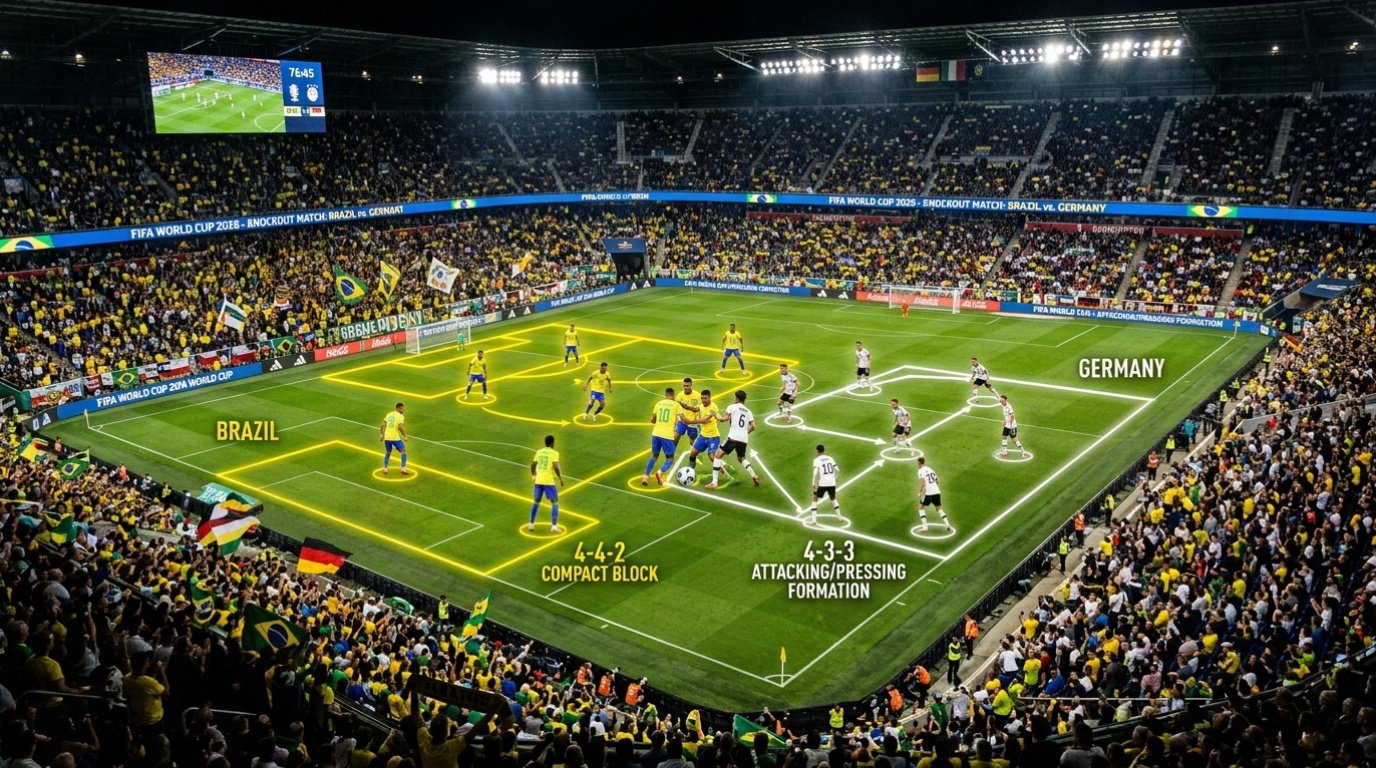
The 2026 FIFA World Cup is currently at its boiling point. As of July 4th, the Round of 16 has concluded, and the world's eyes are fixed on the quarter-finals unfolding across the United States, Canada, and Mexico. While the tournament has delivered breathtaking goals and dramatic penalty shootouts, the underlying story is a profound tactical shift.
For nearly two decades, global football was dominated by the individual brilliance of Lionel Messi and Cristiano Ronaldo. However, this World Cup arguably the last major international tournament for the final remnants of that generation has solidified a new reality. The post-Messi/Ronaldo era is not defined by a lack of stars, but by a fundamental tactical upheaval where systems, data, and collective pressing have triumphed over raw, individual magic. Without a singular hero to rely on, managers have turned to mathematics and structure.
The Resurgence of the Two-Striker System
One of the most surprising yet undeniable trends observed at this 2026 World Cup has been the dramatic return of the 4-4-2 formation. Once dismissed as outdated by modern analytics, this classic setup has been weaponized by several top contenders to counter the possession-heavy 4-3-3s that dominated the 2018 and 2022 tournaments.
Why the 4-4-2 Works in 2026
The expanded 48-team format has introduced a greater disparity in quality between the top and bottom seeds. Lower-ranked teams have adopted the 4-4-2 to provide defensive compactness and double-mark key opposition playmakers. However, it is the top teams that have popularized it most effectively in the knockout stages.
- Balanced Width: The four midfielders provide natural coverage against wing-heavy attacks, forcing opponents to play through congested central areas.
- Counter-Pressing Triggers: With two forwards, teams can initiate high presses without sacrificing an outlet for a quick transition, a trend visible in Brazil's current campaign.
- Diagonal Exploitation: Managers have realized that attacking diagonally into the channels behind the opposition full-backs is best executed when you have a target man and a poacher in the box simultaneously.
“The 4-4-2 is back because football is cyclical. With the extreme athleticism of modern wingers, you need two banks of four to deny them space. The nostalgia is over; this is functional efficiency.”
This sentiment, echoed by multiple pundits on Sky Sports during the post-match analysis of the group stages, has proven accurate. Brazil, under their new manager, have utilized a fluid 4-4-2 that shifts into a 4-2-4 during attacks, overwhelming defenses with sheer numbers in the box. Their success in navigating a tricky group was largely attributed to this structural flexibility.
The Collapse of Passive Possession
We are witnessing the death of "possession for possession's sake" at this World Cup. In the group stages, teams that averaged over 65% possession actually lost more matches than they won, a stark statistical anomaly compared to previous decades. Spain, despite their technical quality, struggled to break down compact defenses, highlighting the inefficiency of tiki-taka in the modern high-press environment.
Why is this happening? Because pressing structures have evolved exponentially. Teams are employing aggressive man-to-man marking in the opponent's half, forcing goalkeepers and defenders to play long balls into congested midfield zones. The result is a chaotic, end-to-end style of play that prioritizes shot volume over buildup elegance.
- Direct Play: Long balls are no longer seen as a "route one" tactic but a calculated risk to bypass the first pressing line and exploit space behind high defensive lines.
- Transitional Goals: According to the official FIFA match statistics released this week, over 70% of the goals scored in the 2026 World Cup so far have come from transitions (counter-attacks or turnovers), compared to just 40% in the 2018 tournament.
The Evolution of Man-to-Man Pressing
The pressing triggers have fundamentally changed. While the 2022 World Cup saw a mix of zonal and man-marking, the 2026 iteration has firmly shifted towards aggressive man-to-man principles, even in the high blocks.
Take France's performance against a strong African opponent in the Round of 16. Their forwards didn't just press the ball carrier; they tracked the deep-lying midfielders man-for-man, cutting off the supply lines to the striker. This "extreme pressing" requires immense physical conditioning, but with the tournament held in the North American summer heat (temperatures exceeding 35°C in some host cities), we are seeing fatigue become a decisive tactical factor. Teams that rotated their squads effectively have thrived, while those relying on a fixed starting eleven have dropped off significantly in the second halves.
Data Analytics Driving In-Game Decisions
The tactical revolution is also being fought in the analysts' booths, not just on the training pitch. The use of Expected Goals (xG) and Expected Assists (xA) has transitioned from post-match analysis to real-time decision-making. Several managers have been spotted reviewing tablets on the touchline to check heat maps and passing networks, a sight that was rare just four years ago.
Substitutions Based on Data
We have seen unprecedented tactical substitutions based on live metrics. In the group stages, Germany's manager made a triple substitution at half-time, not because of poor performance, but because the data showed the opposition's left-back was winning 90% of his duels in the first half. By replacing the left-winger with a faster, more direct dribbler, they successfully flipped the statistical trend and won the match 3-2. This data-driven approach is the new frontier of international management.
“It’s no longer just about the eye test. The metrics tell us where the gap is. If a winger is out of position for 60% of his defensive transitions, we can identify that in the first 20 minutes and adjust. That's the modern game at this World Cup.”
The "False Nine" and Fluid Attacking Roles
While the 4-4-2 is making a comeback, it doesn't mean the false nine is dead. In fact, it has evolved into something more complex. Several teams are utilizing a "Nomadic Striker" who drops deep to create numerical overloads in midfield, allowing the two attacking midfielders to break forward into the vacated space.
England, for instance, has employed a young false nine who interchanges frequently with the wingers. This creates "diamond" shapes in midfield that are notoriously difficult to mark in a zonal system. However, the challenge remains evident: to execute this fluidity, you need players with the exceptional technical IQ of the previous generation. This highlights the struggle of the post-Messi era; the tactics are evolving to fit the new physical specimen, but the technical purity is often missing, leading to more errors and consequently, more entertaining, open games for the neutral fan.
How the Expanded 48-Team Format Affects Strategy
We cannot discuss the tactical landscape of the 2026 World Cup without addressing the elephant in the room: the expansion to 48 teams. The group stage now consists of 16 groups of three teams, meaning only two matches per team in the first round.
- Conservative Starts: With only two guaranteed matches in the group (and the high probability of progressing on a draw), teams started extremely conservatively. The first game of every group saw an average of just 1.1 goals, as neither side wanted to risk a loss that would virtually eliminate them.
- Knockout Edge: However, once the knockout stage began, the shackles came off. The single-elimination format has produced some of the most aggressive attacking football seen in decades, as teams abandon tactical caution once they are 15 minutes away from elimination. The USA's thrilling comeback against a European giant in the Round of 16 is a prime example of this "win or go home" mentality overriding structural fear.
Coaching Masterclasses at the Tournament
Unlike the club season, where managers have weekly training sessions to drill patterns, international tournaments are about quick assimilation. The managers who have succeeded at this World Cup are those who simplified their tactical instructions without sacrificing complexity.
We have seen the emergence of younger coaches who treat tactics like a chess match, making micro-adjustments after every 15 minutes of play. Meanwhile, the veteran managers who stuck rigidly to their historical "philosophy" have often been punished by the new wave of adaptive, system-oriented coaches.
The shift from superstar dependency to tactical adaptability is the hallmark of this tournament. Without a Messi or Ronaldo to bail them out with a moment of magic, teams can no longer afford to play poorly for 80 minutes and hope for a miracle. Every phase of the game is scrutinized, and every loss is attributed to structural deficiencies rather than individual misfortune.
The Future of the Game
As we look ahead to the semi-finals scheduled for next week and the eventual final on July 19th at MetLife Stadium in New Jersey, one thing is certain: football has entered a new age. The reliance on individual superstars has been replaced by the supremacy of tactical systems. The pendulum has swung from the individual to the collective.
The game is faster, more physical, and statistically driven than ever before. We are seeing a beautiful chaos where direct counter-attacks are celebrated, and high-pressing is the non-negotiable norm. The tactical evolution is real, and while we may miss the sheer artistic brilliance of the past two decades, the strategic depth and competitive parity of the current game offer a uniquely compelling narrative of its own.

