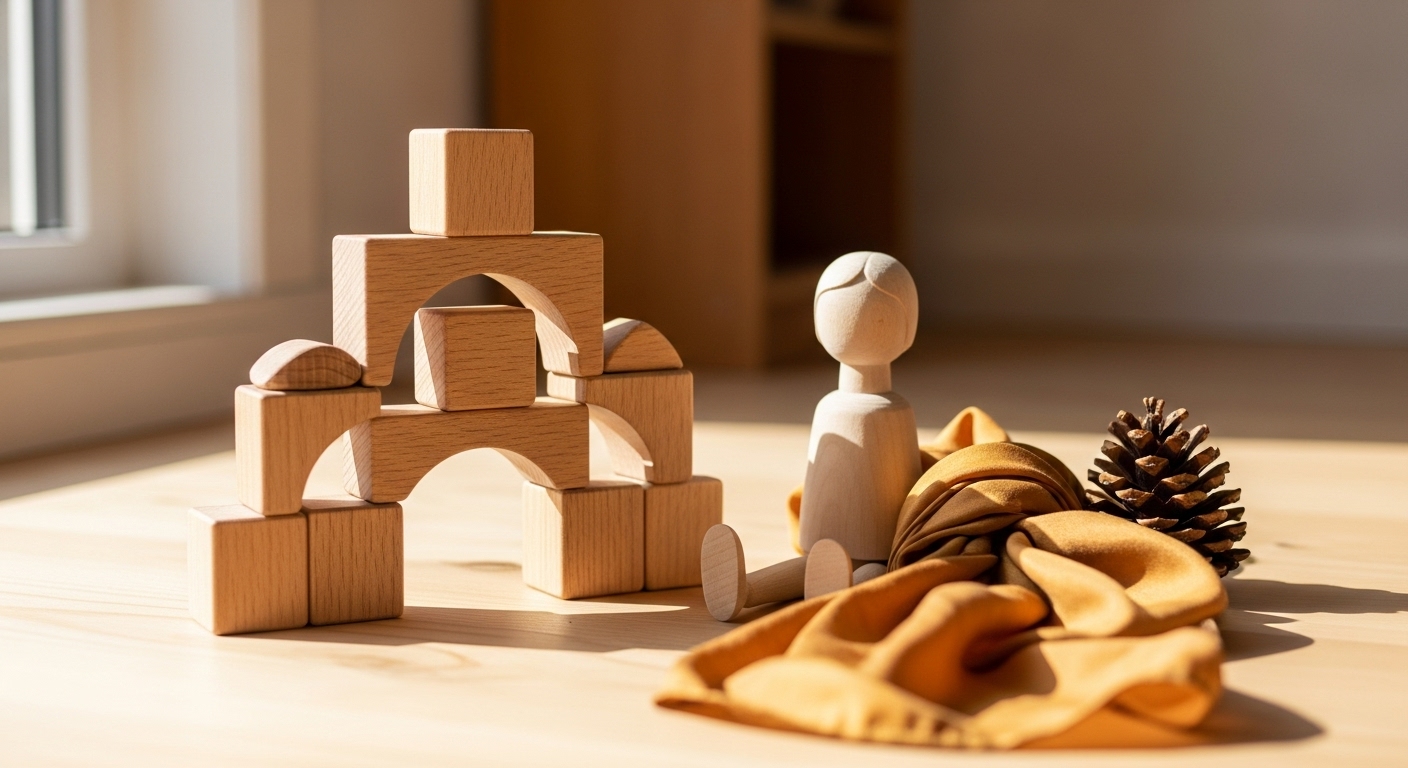
Walk down any toy aisle, and you’re hit with a wall of stimulus: lights blinking, songs looping, cartoon characters shouting branded phrases. The promise is clear: this toy will teach, entertain, and engage. But for a growing number of parents and educators, there’s a quiet counter-movement gaining ground. It’s a return to the simple, the open-ended, and the decidedly low-tech. It turns out, this isn’t just nostalgia or an aesthetic preference. A compelling body of developmental science suggests that the simplest toys aren’t a step back—they’re often the smartest, most sophisticated choice we can make for a child’s developing brain.
The best toy is 90% child and 10% toy. It’s a prop for the imagination, not a script for it.
When a Toy Doesn’t Do the Work, the Child Has To
The fundamental difference lies in who holds the agency. A battery-operated dinosaur that walks and roars has one purpose. It dictates the play. A set of smooth wooden blocks, however, is a universe of potential. They can be a tower, a train, a wall, or food in a pretend kitchen. This open-endedness is neurologically demanding in the best possible way. It requires a child to generate the idea, plan the action, and execute it—exercising what psychologists call executive functions.
Dr. Elena Bodrova, a co-author of the book Tools of the Mind, frames this type of play as essential cognitive training. “When play is structured and directed by the toy itself,” she notes, “children are passengers. When play is open-ended, they are the drivers, navigating their own thoughts and building crucial neural pathways for problem-solving and self-regulation.” A 2018 study in the journal Infant and Child Development found that children engaged in more complex, sustained narrative play and demonstrated greater cognitive flexibility when playing with simple, non-realistic toys compared to highly detailed, single-purpose ones.
The Sensory Argument: Wood, Wool, and Warmth
There’s also a deeply human element to materiality. A cold, light piece of plastic that makes a tinny sound offers one kind of feedback. A solid wood block has a certain heft, a grain you can feel, a subtle scent, and a satisfying, muffled *thud* when it falls. A silk scarf floats and drapes. These varied sensory experiences are not frivolous; they’re data for a developing sensory system.
Research into sensory integration theory, pioneered by Dr. A. Jean Ayres, highlights how the brain organizes input from touch, proprioception (body awareness), and sight. Natural materials provide a richer, more nuanced, and calmer sensory diet than the overstimulating buzz and flash of electronics. This calmer input can be particularly grounding, helping children self-regulate and focus—a benefit any parent of an overstimulated toddler can appreciate.
The “Slow Toy” Movement and the 100-Hour Plaything
This philosophy has a name: the “slow toy” movement. It champions toys made from natural materials, with thoughtful craftsmanship, designed to last for generations. It’s a direct rebuttal to the “fast toy” culture of cheap, disposable plastic that breaks quickly and loses a child’s interest faster.
The economic and environmental logic is clear, but the developmental logic is sharper. A simple toy like a classic set of Grimm’s wooden rainbows or a plain doll can be used in a hundred different ways across a childhood. A toddler stacks the pieces; a preschooler uses them as bridges for cars; a school-age child incorporates them into elaborate fantasy landscapes. The toy evolves with the child. This longevity isn’t just about durability; it’s about cognitive depth. The child builds a longer, more personal history with the object, which in turn fuels more complex and layered play.
What This Means for the Conscious Parent
You don’t need to throw out every plastic toy. The shift is more about mindset than a purge. It’s about curating a play environment that privileges possibility over programming.
Start by looking for toys that fail the “what is it?” test. If a child looks at it and can only think of one thing to do, its potential is limited. Instead, favor the ambiguous: cloths, blocks, rings, peg dolls, bowls, and natural loose parts like stones and shells. Rotate toys to keep the environment fresh and manageable. You’ll likely notice a decrease in playroom chaos and an increase in the depth and duration of your child’s play sessions.
It also means giving yourself permission to do less. The pressure to provide constant, adult-directed, educational entertainment is immense. Embracing simple toys is also about trusting that a child’s own mind, given the right unstructured space and simple tools, is the most powerful learning engine of all. Our role isn’t to fill the time, but to provide the fertile ground.
The Lasting Gift
In the end, choosing a simple toy is about the story you want a child to learn about themselves. A flashy toy whispers, “The fun is out here, in what I can do for you.” A simple block says, “The fun is in you, in what you can create.” One fosters consumption; the other cultivates capability.
The goal isn’t to raise a child who is passively entertained, but one who can actively invent, solve, and imagine. That skill—the ability to generate your own curiosity and engagement from the raw materials of the world—is perhaps the most valuable one we can nurture. And it often starts not with a microchip, but with a piece of wood.