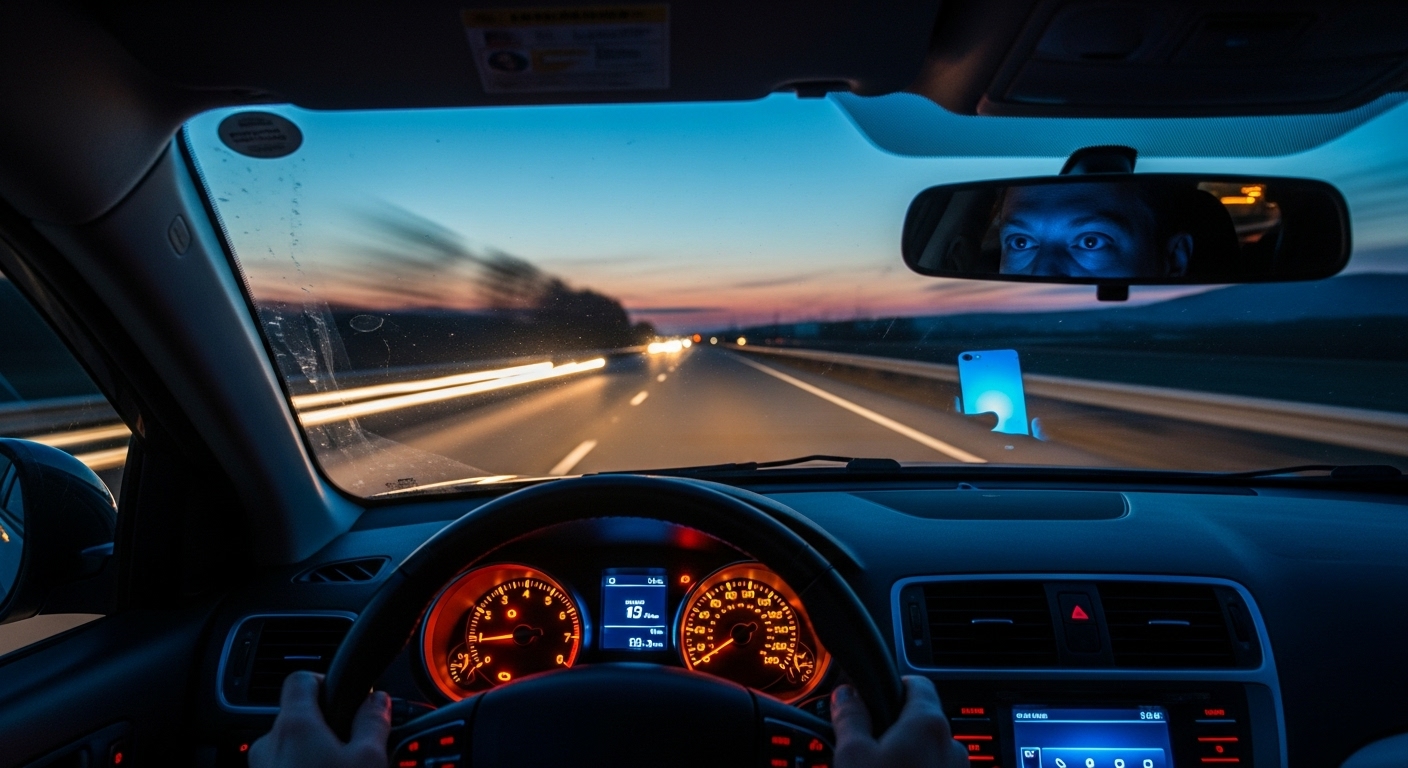
We are meticulous about maintenance. We track oil changes, rotate tires, and listen for the faintest new rattle. We treat our cars as collections of mechanical systems, each with a service schedule and a wear indicator. But this careful stewardship ignores the most critical, and most degraded, component in the vehicle—one that isn't listed in any manual. It's the driver's attention. And while engines have redundancies and brakes have warning signs, human focus wears out silently, catastrophically, and is being actively eroded by the very world the car moves through.
The modern car is a fortress of safety tech, but it navigates a world designed to besiege the one system it can't automate: the driver's mind.
The Myth of Multitasking and the Cognitive Budget
Let's start with a foundational fact, validated by decades of neuroscience: **The human brain does not multitask.** It toggles. Every switch between tasks—from watching the road to glancing at a notification—incurs a "switch cost" in time and cognitive accuracy. A seminal study by David Strayer at the University of Utah found that talking on a phone, even hands-free, reduces brain activity associated with driving by **37%**. The driver's eyes may be on the road, but a significant portion of their cognitive map has gone offline.
We operate with a finite cognitive budget. Driving, especially in complex urban or highway environments, is a high-demand task that requires continuous environmental scanning, pattern prediction (is that pedestrian going to step out?), and micro-adjustments. It consumes most of that budget. Adding any other conscious task—programming a GPS, having an emotional conversation, listening to a dense podcast—creates cognitive overload. The brain's response isn't to do both poorly; it's to shed the less immediately demanding task, which is often the peripheral monitoring essential for hazard prediction.
The Slow Erosion of Situational Awareness
This isn't just about the dramatic glance at a text. It's about the chronic, low-grade attrition of what pilots call "situational awareness"—the accurate perception of environmental elements, comprehension of their meaning, and projection of their status into the near future.
Consider the common habit of passive podcast or audiobook consumption. While it feels efficient, research published in the Journal of Experimental Psychology: Applied suggests that absorbing narrative or complex information can monopolize the brain's verbal and spatial working memory resources. This can lead to "inattentional blindness," where you physically see a hazard—a brake light, a cyclist—but fail to *perceive* it as relevant because your cognitive resources are allocated elsewhere. Your situational awareness isn't hacked; it's slowly starved.
The Deceptive Comfort of Driver "Aids"
Paradoxically, the very technology designed to make driving safer may be accelerating the wear on our attention. Adaptive cruise control, lane-keeping assist, and blind-spot monitors are brilliant at handling specific, well-defined tasks. But the human brain is notoriously poor at passive monitoring. In a phenomenon known as "automation complacency" or "out-of-the-loop syndrome," studied extensively in aviation, when a system is highly reliable, the operator's vigilance plummets.
The driver becomes a supervisor rather than an operator, a role for which our brains are ill-suited over long periods. When a system fails or encounters an edge case (debris in the road, faded lane markings in a storm), the drowsy, disengaged attention must snap back to full operational capacity instantly—a transition that data shows can take dangerous seconds. We're not maintaining our attention; we're letting the car's systems babysit it, and like any muscle, unattended focus atrophies.
Recalibrating the Human Component
If attention is a wear item, then it demands its own maintenance schedule. This requires a shift from seeing driving as a passive transit to recognizing it as a dynamic skill requiring active management.
1. Perform a "Cognitive Pre-flight": Before driving, set your climate, playlist, and navigation. See this not as fussiness, but as essential system configuration, eliminating task-switching during critical phases of travel.
2. Practice "Mindful Driving": Periodically, turn off the audio. For a ten-minute segment of your commute, just drive. Actively scan your mirrors, predict the actions of other cars, feel the vehicle's feedback. This isn't wasted time; it's a calibration exercise for your attention, reinforcing the neural pathways for situational awareness.
3. Redefine "Hands-Free": Understand that "hands-free" is not "brain-free." The most dangerous distraction is cognitive, not manual. Treat a phone conversation in the car with the same gravity you would if you were holding the device.
4. Schedule Attention Breaks: On long trips, a break isn't just for your body or the car's engine. It's a hard reset for your attention. Get out, walk, let your mind engage with a different environment. You're not resting your eyes; you're rebooting your perception.
The Ultimate Upgrade
In an era where we can upgrade horsepower, suspension, and infotainment with a software download, the most impactful performance mod remains profoundly analog. It's the deliberate, sustained investment in the cognitive software between our ears. The car you drive is a marvel of engineering, but its safety, efficiency, and enjoyment are ultimately filtered through the worn, wonderful, and distractible lens of human attention.
Servicing that part doesn't require a mechanic. It requires honesty, intention, and the recognition that every trip is a shared journey between machine, road, and a mind that needs its own kind of careful, constant tuning.