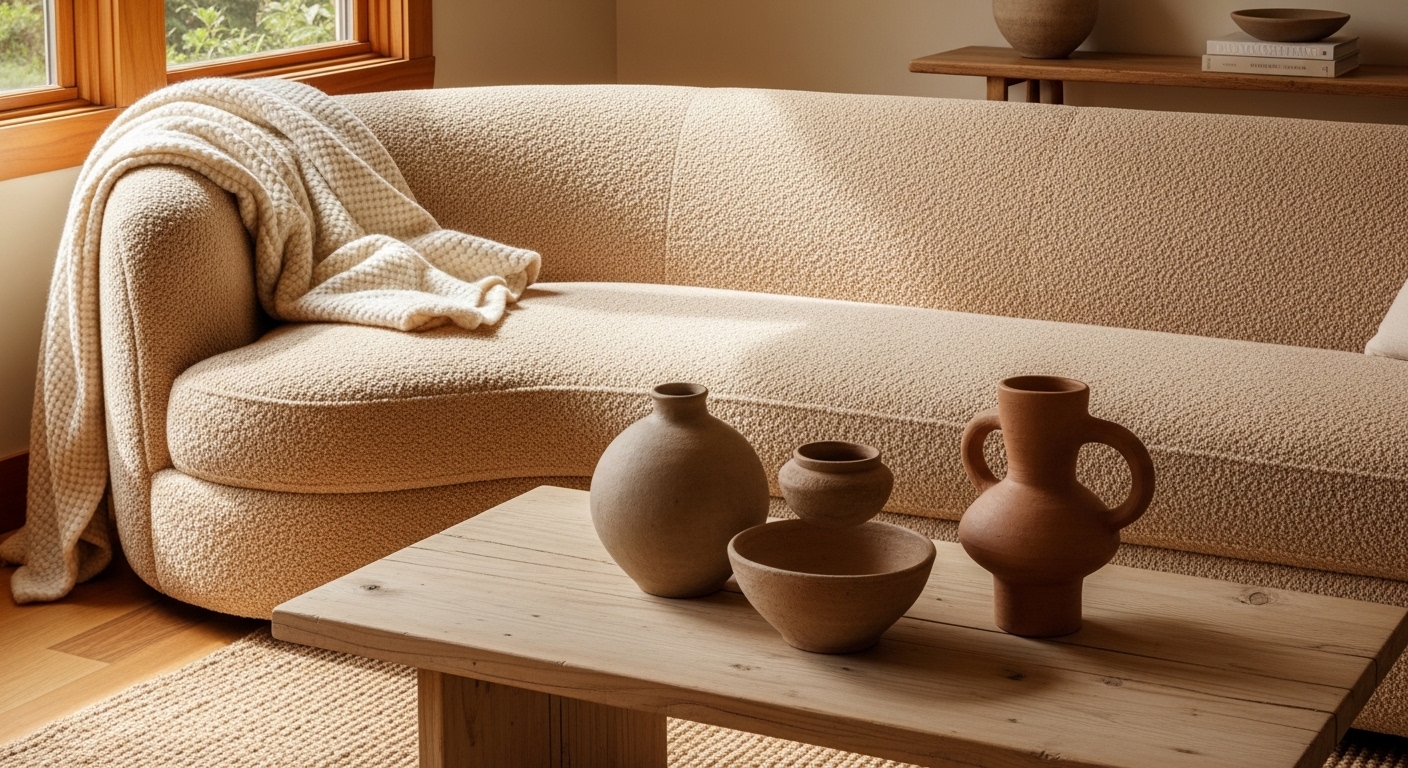
Walk into any furniture store and you will see rows of sofas that look like they were designed for a waiting room. Straight lines. Sharp edges. Colors that say "practical" but never "come sit down." Then you sit on one, and it confirms what your eyes already knew: this piece was built to be looked at, not lived on.
The furniture that is filling homes right now takes a different approach. Soft curves that wrap around you. Rich earth tones that ground the room. Textures so inviting you cannot help but reach out and touch. This is not furniture designed for magazines. It is furniture designed for real life—the kind you sink into at the end of a long day and do not want to leave.
At the center of this movement is the bouclé sofa. If you have spent any time on interior design feeds, you have seen it: the rounded silhouette, the nubby texture, the color that somehow goes with everything while feeling like something. It is everywhere for a reason.
Why Bouclé Became the Fabric Everyone Wants
Bouclé is not new. The fabric has been around since the 1940s, popularized by designers like Coco Chanel for her iconic jackets. What is new is its migration from fashion to furniture—and the way it has captured the collective imagination of people who want their homes to feel different than they did a decade ago.
The name comes from the French word for "curl" or "loop," which describes the fabric's distinctive texture. Looped yarns create a surface that is soft, nubby, and visually interesting without being loud. It catches light differently than flat fabrics. It invites touch. It makes a sofa look like something you want to curl up on, not something you are afraid to spill on.
Bouclé's appeal goes beyond aesthetics. In a world where most furniture fabrics are chosen for durability over comfort, bouclé prioritizes how a piece feels. It is soft without being precious. It has texture without being scratchy. It makes a room feel lived-in from the day it arrives.
The practical concerns people have—will it pill, will it stain, will it hold up to kids and pets—are valid. High-quality bouclé is dense and tightly woven. It resists pilling better than cheaper versions. Spills should be addressed quickly, as with any upholstery. But this is not a fabric that needs to be treated like museum glass. It is made for living.
The Shift to Soft Curves
For years, furniture followed architecture: straight lines, right angles, clean edges. The thinking was that modern meant minimal, and minimal meant sharp. But something shifted in the past few years. People started wanting spaces that felt less like galleries and more like sanctuaries.
The curved sofa is the clearest expression of that shift. Rounded backs, softened arms, silhouettes that seem to wrap around you. These are not design flourishes—they fundamentally change how a piece functions. A curved sofa defines space differently than a straight one. It creates a sense of enclosure, of intimacy, of being held.
Place a curved sofa in the center of a room, and it becomes the natural gathering point. It invites conversation. It does not need to be pushed against a wall to feel intentional. In smaller spaces, curves actually make rooms feel larger by eliminating the visual weight of sharp corners.
The scale matters too. Curved furniture tends to feel more approachable than its rectilinear counterparts. A massive sectional with hard edges can dominate a room. A curved sofa of the same dimensions somehow feels softer, less imposing, more like an invitation than a statement.
Rich Earth Tones: The Colors That Ground a Room
The color palette that accompanies this furniture shift is unmistakable. Gone are the grays that dominated for a decade. In their place: warm beiges, terracottas, deep olives, rusts, and the browns that used to be dismissed as boring.
These earth tones do something that cooler colors cannot. They make a room feel grounded. They connect indoor spaces to the natural world outside. They create warmth without relying on artificial light or a fireplace. And they have a remarkable ability to make other colors—whether you bring them in through art, textiles, or plants—look intentional.
A sofa in a warm oatmeal or rich terracotta does not fight with the rest of your room. It becomes the foundation, the anchor, the piece that makes everything else work. This is why designers reach for these tones again and again: they are versatile without being neutral, distinctive without being demanding.
The earth tone palette also ages better than trend-driven colors. A sofa you buy today in a warm clay or muted olive will not look dated in five years. It will look like a classic. The same cannot be said for the millennial pink or stark white sofas that filled showrooms just a few years ago.
How to Build a Room Around Curves, Texture, and Earth Tones
Bringing these elements into your home does not require starting from scratch. A single piece—the curved bouclé sofa, the terra cotta coffee table, the olive accent chair—can anchor a room while the rest of your existing furniture adapts around it.
Start with the sofa. If you are replacing one piece, let it be this. A curved bouclé sofa in a warm neutral sets the tone for everything else. From there, layer in other textures: a chunky wool throw, a linen pillow, a jute rug. The contrast between the sofa's nubby texture and smoother materials creates depth without color.
Add warmth through wood tones. Oak, walnut, and teak all complement earth tones. A simple wooden coffee table, perhaps with its own soft edges, grounds the sofa. Floating shelves in natural wood bring the eye upward without introducing competing colors.
Bring in plants. The connection between earth tones and actual earth is obvious once you see it. A room anchored by terracotta and olive comes alive with the addition of greenery. Fiddle leaf figs, snake plants, and trailing pothos all thrive in the indirect light of most living rooms and add a layer of organic texture that no object can replicate.
Lighting matters more than people realize. Warm bulbs (2700-3000K) make earth tones glow. Cool bulbs make the same colors look flat. The difference is immediate and dramatic. If your room feels off despite having all the right pieces, check your light temperature.
The Furniture That Lasts
The appeal of this style goes beyond aesthetics. These pieces are built differently than the fast furniture that filled homes for the past decade. They are meant to last.
Quality curved furniture requires more material and more skilled construction than straight pieces. The frames are typically hardwood, the joinery is reinforced, the cushions are high-density foam wrapped in down or fiber. This is not furniture designed to be replaced every few years. It is furniture designed to be recovered when the fabric wears out, to be passed down, to become part of a home's history.
Bouclé, when well-made, ages beautifully. The texture softens with use. The color develops a subtle patina. It becomes more interesting over time, not less. This is the opposite of the disposable furniture model that taught people to expect stains, sagging, and disappointment within a few years.
The price point reflects this difference. Quality curved furniture costs more than the straight, mass-produced pieces you will find at big box stores. But the cost per use, over the ten or fifteen years a well-made sofa should last, ends up being lower than replacing cheaper pieces every few years.
Making It Work in Your Space
If you are worried that curves and bouclé and earth tones will not work in your home, you are not alone. Every design shift comes with the fear that what works in inspiration photos will look out of place in real life. But this particular style is more adaptable than it seems.
A curved sofa works in small spaces precisely because it does not need to be pushed against a wall. Float it in the room, and it defines zones without blocking light. The curves themselves make tight spaces feel less cramped by eliminating hard edges that visually constrict.
Earth tones work with virtually any existing color palette. If your walls are gray, a warm sofa creates contrast that feels intentional. If your walls are white, earth tones add the warmth that all-white rooms need. If your walls are already in the earth tone family, you are ahead of the game.
Bouclé works with other textures. If your existing furniture is leather, the contrast between smooth and nubby is exactly what designers aim for. If your existing furniture is velvet, the two textures complement each other without competing. If your existing furniture is also bouclé, you are either very trendy or very intentional—both are valid.
The key is not to overthink it. This style, more than many others, rewards instinct. If a piece feels right, if you want to touch it, if it makes you want to sit down and stay a while, it probably belongs in your home.
The Investment in Your Daily Life
Furniture is not like art. Art you look at. Furniture you live on. The pieces you choose shape how you spend your evenings, your weekends, the moments in between when you are not thinking about design at all.
A sofa that feels like a hug changes how you use your living room. You stay there longer. You invite people over more often. You look forward to coming home not because the space is beautiful—though it will be—but because it is comfortable in the way that matters most: it makes you want to be there.
The soft curves, the rich earth tones, the tactile fabric—these are not just trends. They are responses to how people actually live. People want to come home to spaces that feel like they were designed for them, not for a photographer. They want furniture that invites them to sit, to stay, to rest.
The furniture that delivers that feeling is worth waiting for, worth saving for, worth making space for. It is the piece that makes a house feel like a home. And when you find it, you will know.
Final Thoughts
The curved bouclé sofa in an earth tone is having a moment. But it is also something more than a moment. It is a return to furniture that prioritizes how it feels over how it looks in a catalog. It is a rejection of the sharp, cold, unapproachable pieces that dominated for too long. It is a reminder that the best rooms are the ones you want to be in.
Whether you buy the exact piece that inspired this article or something entirely different, the principle holds: your furniture should work for you. It should invite you to sit. It should make you want to stay. It should feel less like a design decision and more like a natural extension of how you live.
That is what soft curves, rich earth tones, and tactile fabrics deliver. Not a trend. Not a statement. Just the feeling of coming home to something that feels like it was always meant to be there.