
Librarian's Note
"This curation represents a cornerstone of our collection, chosen for its unique perspective and enduring value."
The Anatolian Silence
by Pattern Observed
In the whispering, patriarchal confines of 13th-century Konya, a city of Sufi mystics and rigid clerical power, Elif is a vessel of silent stories. Born mute, her world is the women’s carpet workshop, a place of vibrant colors and enforced quiet. Her mother taught her that a rug is not just a prayer mat; it is a hidden language. Each knot can hold a secret, a grievance, a dream. Elif becomes an archivist of the unspoken, weaving the sighs of beaten wives, the stifled laughter of girls, and the quiet despair of childless mothers into the margins of her magnificent rugs. Her silence is her armor and her canvas.
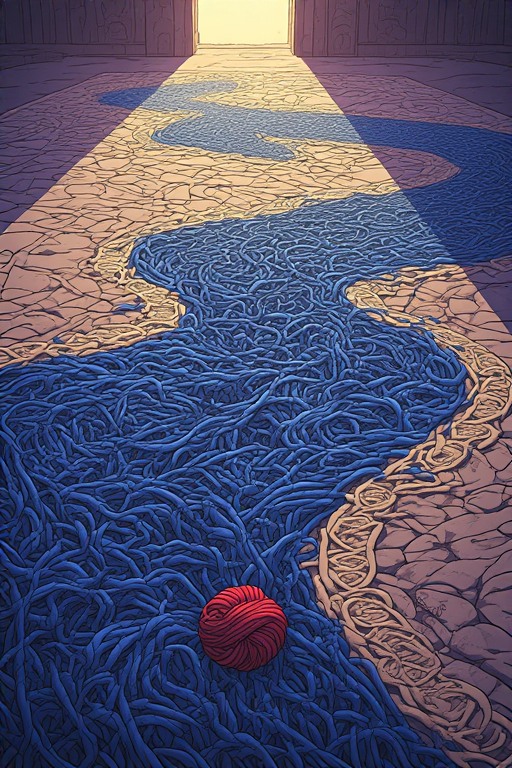
The central conflict arrives with Sheikh Emir, a man of formidable intellect and unwavering conviction in divine order. Commissioning a grand rug for the new mosque, he demands a pattern reflecting perfect, immutable geometry. When Elif’s hands touch the wool for this sacred task, however, the threads rebel. They carry a memory deeper than her own—the memory of the land itself. The city, in its zeal to build monuments to heaven, has buried and cursed the ancient underground rivers that once nourished it. The wool, dyed with plants that drank from those waters, now whispers of their rage. Unbidden, prophecies in fiber emerge under Elif’s fingers: swirling currents, drowning forms, and finally, a cryptic blue bird of escape.
Elif’s journey becomes a desperate act of translation. She must make the silent prophecy seen, to bridge the chasm between the intuitive, embodied knowledge of the women and the text-based, rigid logic of the male religious authority. Her unlikely ally is Kemal, the Sheikh’s sensitive student, who is drowning in dogma and yearns for a faith that feels fluid and alive. Their wordless communion—a shared glance at a bleeding indigo pattern, a map sketched on dirt—forms the emotional core of the story. As drought strangles the city and the Sheikh brands her work heretical, Elif must decide whether to unravel her warning or complete it, knowing it will cost her the only home and identity she has.
The stakes are both cataclysmic and intimate. The physical flood is coming, a reckoning for the earth’s violated waterways. But the deeper deluge is one of truth. Will the city drown in its own rigidities, or can it learn to listen to the voices it has silenced—the voices of women, of water, of the very land it stands upon? Elif’s rug becomes a focal point for this battle, a tangible scripture written in wool that challenges the official scriptures written in ink.
The synopsis concludes not with a simple victory, but with a transformation. The flood, when it comes, is a cleansing rather than an annihilation. It washes away certainties but not the city. In the damp, new world, roles are fluid. The Sheikh is humbled by a reality that defied his texts. Kemal finds his calling not in commentary, but in cartography of the unseen. And Elif? She does not gain a voice. Instead, she becomes a source. She weaves the new story, the story of a city that learned, painfully, to hear its own silence. Her legacy is not a spoken word, but a woven one—a testament that the most profound truths are often those held in the tension of a thread, waiting for a feeling heart to read them.
The central conflict arrives with Sheikh Emir, a man of formidable intellect and unwavering conviction in divine order. Commissioning a grand rug for the new mosque, he demands a pattern reflecting perfect, immutable geometry. When Elif’s hands touch the wool for this sacred task, however, the threads rebel. They carry a memory deeper than her own—the memory of the land itself. The city, in its zeal to build monuments to heaven, has buried and cursed the ancient underground rivers that once nourished it. The wool, dyed with plants that drank from those waters, now whispers of their rage. Unbidden, prophecies in fiber emerge under Elif’s fingers: swirling currents, drowning forms, and finally, a cryptic blue bird of escape.
Elif’s journey becomes a desperate act of translation. She must make the silent prophecy seen, to bridge the chasm between the intuitive, embodied knowledge of the women and the text-based, rigid logic of the male religious authority. Her unlikely ally is Kemal, the Sheikh’s sensitive student, who is drowning in dogma and yearns for a faith that feels fluid and alive. Their wordless communion—a shared glance at a bleeding indigo pattern, a map sketched on dirt—forms the emotional core of the story. As drought strangles the city and the Sheikh brands her work heretical, Elif must decide whether to unravel her warning or complete it, knowing it will cost her the only home and identity she has.
The stakes are both cataclysmic and intimate. The physical flood is coming, a reckoning for the earth’s violated waterways. But the deeper deluge is one of truth. Will the city drown in its own rigidities, or can it learn to listen to the voices it has silenced—the voices of women, of water, of the very land it stands upon? Elif’s rug becomes a focal point for this battle, a tangible scripture written in wool that challenges the official scriptures written in ink.
The synopsis concludes not with a simple victory, but with a transformation. The flood, when it comes, is a cleansing rather than an annihilation. It washes away certainties but not the city. In the damp, new world, roles are fluid. The Sheikh is humbled by a reality that defied his texts. Kemal finds his calling not in commentary, but in cartography of the unseen. And Elif? She does not gain a voice. Instead, she becomes a source. She weaves the new story, the story of a city that learned, painfully, to hear its own silence. Her legacy is not a spoken word, but a woven one—a testament that the most profound truths are often those held in the tension of a thread, waiting for a feeling heart to read them.
Table of Contents
01
Prologue: The First Knot
Reading Time: 6m
02
Chapter 1: The Loom of Rûm
Reading Time: 9m
03
Chapter 2: The Commission
Reading Time: 10m
04
Chapter 3: The Whispering Warp
Reading Time: 9m
05
Chapter 4: The Archive of Water
Reading Time: 8m
06
Chapter 5: The Translator
Reading Time: 7m
07
Chapter 6: The Unraveling
Reading Time: 9m
08
Chapter 7: The Fifth Prayer
Reading Time: 8m
09
Chapter 8: The Sound Before the Water
Reading Time: 7m
10
Chapter 9: The City of Wet Stones
Reading Time: 7m
11
Chapter 10: The New Loom
Reading Time: 7m
12
Epilogue: The Seventh Direction
Reading Time: 6m
Rating
PG-13 / 10
Length
12 Chapters
Status
Published
Publisher
Patterns Discovery