
Librarian's Note
"This curation represents a cornerstone of our collection, chosen for its unique perspective and enduring value."
The Copenhagen Resonance
by Pattern Observed
Dr. Kira Larsen is a vessel of exquisite, sterile precision. A leading quantum physicist at the Niels Bohr Institute, she has dedicated her career to eliminating noise, to observing the pristine dance of particles unsullied by the mess of the macro world. Her personal life is a monument to controlled decoherence—after the tragic death of her young daughter, she has carefully collapsed her own emotional wave function into a single, stable state of disciplined solitude. Grief, to Kira, is a form of interference to be isolated and muted.
The central conflict arises from a flaw in her latest, most sensitive experiment: a persistent, non-local "echo" that corrupts every attempt to observe a quantum system in perfect isolation. Colleagues dismiss it as instrument error. But Kira, with a theoretician's intuition and a mourner's hyper-sensitivity, begins to suspect it is memory itself. The vibration has a pattern, a signature. Her investigation leads her out of the lab and into the Copenhagen city archives, where she discovers the echo matches the acoustic resonance of a dressing room in the old Royal Theatre, torn down a century ago. It is the ghost of a place, or perhaps, the ghost in the place.
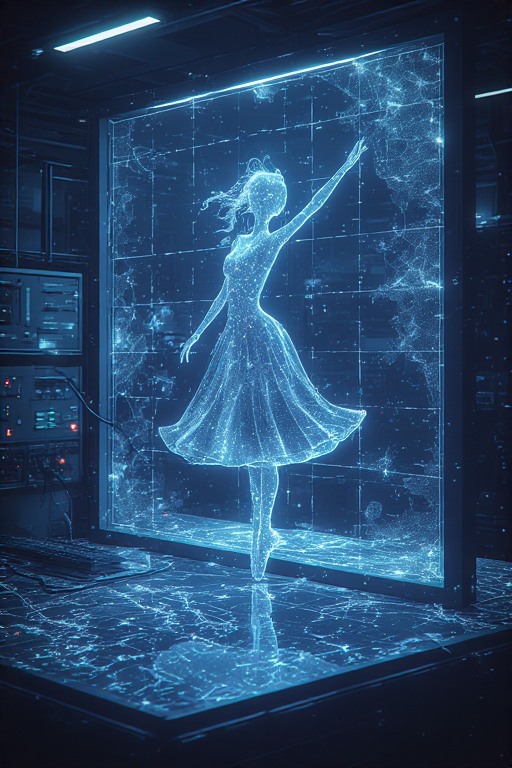
The story becomes a dual excavation. As Kira unearths the history of Linnea Vogel, a brilliant 19th-century ballerina who died with a secret sorrow—a love unconsummated and a child unacknowledged—she is forced to confront her own entombed trauma. She realizes, through a radical synthesis of quantum theory and raw emotion, that Linnea’s moment of death—a catastrophic collapse of possibility into a single, fixed point of anguish—created a kind of "emotional singularity." This singularity did not vanish. It became entangled with the location, a knot in spacetime waiting for an observer with the right resonant frequency to detect it. That observer is Kira, whose own suppressed grief provides the tragic symmetry.
Kira’s journey is one of terrifying, willing entanglement. To silence the ghost in her machine, she must stop trying to erase it and instead learn to listen. She must become a bridge between centuries, allowing Linnea’s unresolved story to intermingle with her own. The stakes are the integrity of her mind, her identity, and the very foundations of her scientific worldview. Is she conducting an experiment, or is the experiment conducting her? As the boundaries between Kira and Linnea blur—their sorrows whispering to each other across time—Kira understands that the Copenhagen Interpretation, which states reality is undefined until observed, applies not just to particles, but to pain. An un-witnessed sorrow remains in a state of terrible superposition.
The synopsis concludes not with an exorcism, but with a completion. Kira understands that to "solve" the resonance, she must perform the ultimate act of observation: one that includes compassion. In a climactic synthesis of science and ritual, she finds a way to bear witness to Linnea’s love and loss, and in doing so, finally bears witness to her own. The ghost does not disappear; it decoheres into history, its energy transformed. Kira is left not with sterile silence, but with a quieter, more complex symphony. She emerges with a new theory: that the universe is not just made of particles and waves, but of stories and their resonances, and that to be a true observer is to become, for a moment, a vessel for the world’s un-sung songs. The lab is quiet, but her heart, for the first time in years, is full of a sound that is no longer noise, but music.
The central conflict arises from a flaw in her latest, most sensitive experiment: a persistent, non-local "echo" that corrupts every attempt to observe a quantum system in perfect isolation. Colleagues dismiss it as instrument error. But Kira, with a theoretician's intuition and a mourner's hyper-sensitivity, begins to suspect it is memory itself. The vibration has a pattern, a signature. Her investigation leads her out of the lab and into the Copenhagen city archives, where she discovers the echo matches the acoustic resonance of a dressing room in the old Royal Theatre, torn down a century ago. It is the ghost of a place, or perhaps, the ghost in the place.
The story becomes a dual excavation. As Kira unearths the history of Linnea Vogel, a brilliant 19th-century ballerina who died with a secret sorrow—a love unconsummated and a child unacknowledged—she is forced to confront her own entombed trauma. She realizes, through a radical synthesis of quantum theory and raw emotion, that Linnea’s moment of death—a catastrophic collapse of possibility into a single, fixed point of anguish—created a kind of "emotional singularity." This singularity did not vanish. It became entangled with the location, a knot in spacetime waiting for an observer with the right resonant frequency to detect it. That observer is Kira, whose own suppressed grief provides the tragic symmetry.
Kira’s journey is one of terrifying, willing entanglement. To silence the ghost in her machine, she must stop trying to erase it and instead learn to listen. She must become a bridge between centuries, allowing Linnea’s unresolved story to intermingle with her own. The stakes are the integrity of her mind, her identity, and the very foundations of her scientific worldview. Is she conducting an experiment, or is the experiment conducting her? As the boundaries between Kira and Linnea blur—their sorrows whispering to each other across time—Kira understands that the Copenhagen Interpretation, which states reality is undefined until observed, applies not just to particles, but to pain. An un-witnessed sorrow remains in a state of terrible superposition.
The synopsis concludes not with an exorcism, but with a completion. Kira understands that to "solve" the resonance, she must perform the ultimate act of observation: one that includes compassion. In a climactic synthesis of science and ritual, she finds a way to bear witness to Linnea’s love and loss, and in doing so, finally bears witness to her own. The ghost does not disappear; it decoheres into history, its energy transformed. Kira is left not with sterile silence, but with a quieter, more complex symphony. She emerges with a new theory: that the universe is not just made of particles and waves, but of stories and their resonances, and that to be a true observer is to become, for a moment, a vessel for the world’s un-sung songs. The lab is quiet, but her heart, for the first time in years, is full of a sound that is no longer noise, but music.
Table of Contents
01
Prologue: The Collapse (Copenhagen, 1883)
Reading Time: 8m
02
Chapter 1: The Noise in the Signal
Reading Time: 7m
03
Chapter 2: The Copenhagen Interpretation of Grief
Reading Time: 7m
04
Chapter 3: A History Written in Vibration
Reading Time: 8m
05
Chapter 4: Linnea's Unfinished Variation
Reading Time: 6m
06
Chapter 5: Entanglement Protocol
Reading Time: 7m
07
Chapter 6: The Observer's Burden
Reading Time: 7m
08
Chapter 7: Decoherence of a Life
Reading Time: 8m
09
Chapter 8: The Superposition of Two Women
Reading Time: 8m
10
Chapter 9: The Final Measurement
Reading Time: 6m
11
Chapter 10: A Quieter Symphony
Reading Time: 6m
12
Epilogue: The Resonance Principle
Reading Time: 6m
Rating
PG-13 / 10
Length
12 Chapters
Status
Published
Publisher
Patterns Discovery