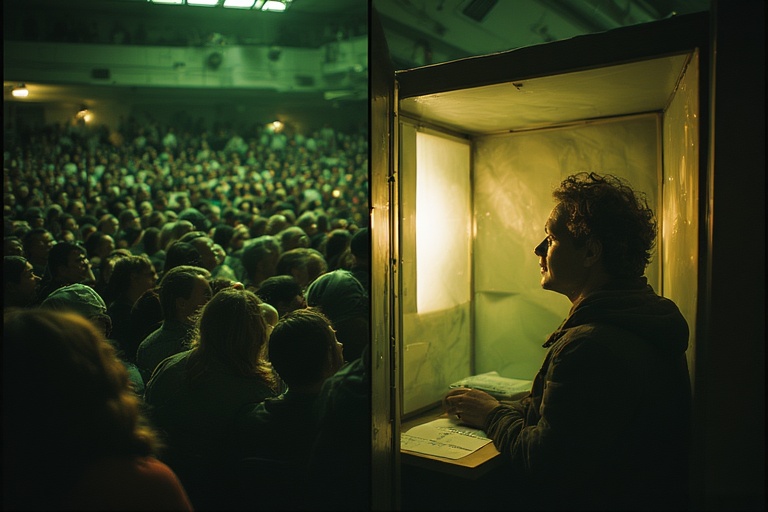
It feels like the world is holding its breath. This past year has been one of the most significant in modern political history, not because of a single event, but due to a cascade of pivotal elections across dozens of nations, encompassing over half the world's population. From the intense political theater of the United States to the vast electoral machinery of India and the pivotal contests across the European Union, citizens have been marching to the polls in a grand, uncoordinated, and deeply consequential test of democratic systems. The central question hanging over it all is not just who won or lost, but what the collective verdict says about the health and direction of global governance itself.
"Elections are the thermometer of a democracy, not the cure. They tell us how high the fever is, but they don't always prescribe the medicine."
What we are witnessing is a fundamental tension, a tug-of-war between two powerful forces. On one side, there is a potent wave of populist and nationalist sentiment, often fueled by economic anxiety and a deep-seated distrust of established institutions. On the other, there is a resilient, if weary, defense of liberal democratic norms, international cooperation, and the slow, often frustrating, work of bureaucratic governance. The results have been a mixed bag, a clear sign that there is no single, unified global mood, but rather a series of fierce, localized battles reflecting unique national histories and contemporary struggles.
The Battle for the Center: Stability vs. Disruption
In many Western democracies, the political center has become a battleground rather than a safe haven. For decades, politics often operated on a relatively stable left-right spectrum. Today, that spectrum is being pulled and stretched into new dimensions, with a new axis emerging: the clash between the pro-system "establishment" and the anti-system "disruptors."
This isn't merely an ideological debate; it's a structural one. The disruptors argue that the entire system is corrupt, inefficient, and rigged against the common person. Their campaigns are often built on charismatic leadership and a promise to dismantle the existing order. The establishment forces, meanwhile, campaign on a platform of competence, stability, and the protection of democratic institutions. The recent European Parliament elections served as a perfect microcosm of this struggle. While populist parties made significant gains in several major countries like France and Germany, prompting swift political repercussions, the broader pro-European coalition managed to hold its ground, suggesting a continent both anxious about change yet unwilling to fully abandon the project of integration.
It brings to mind a classic social science experiment known as the "prisoner's dilemma," where two individuals must choose between cooperating for a moderate mutual benefit or betraying the other for a greater personal gain, at the risk of a worse collective outcome. Voters in many nations seem to be grappling with a similar choice on a societal scale: do they cooperate with the established system for perceived gradual progress, or do they defect, betting on a radical shift that promises greater rewards but carries the known risk of profound instability?
The New Campaign Front: Digital Town Squares and Information Wars
The physical campaign rally is no longer the primary arena. The most decisive battles are now fought in the digital realm—on social media platforms, in encrypted messaging apps, and through targeted advertising. The very nature of information has changed, and with it, the playbook for political victory. Disinformation, once a background nuisance, has become a central weapon, capable of shaping narratives and deepening societal fractures at an unprecedented scale and speed.
Campaigns now employ sophisticated teams dedicated to data analytics and micro-targeting. They can identify specific voter segments with surgical precision, delivering custom-tailored messages, and sometimes, deliberately different versions of the truth. This creates a fragmented public sphere where shared facts are increasingly rare. The role of platforms like TikTok, Telegram, and X (formerly Twitter) is paradoxical; they can energize and engage a new generation of voters while simultaneously serving as conduits for conspiracy theories and foreign influence operations. Regulating this digital wild west without infringing on free speech remains one of the most daunting challenges for democracies worldwide.
The Enduring Power of the Local Issue
Despite these global trends, the most powerful force in any election is often hyper-local. While international media focuses on grand narratives about democracy versus authoritarianism, the average voter is frequently motivated by the price of bread, the quality of local schools, the daily commute, and the safety of their neighborhood.
In India's recent colossal electoral exercise, for instance, national security and Hindu nationalism were powerful themes, but in countless constituencies, the election was decided on the government's performance in delivering welfare benefits, building rural roads, and ensuring water access. Similarly, in the United States, while the presidential race captures all the oxygen, down-ballot races for school board, sheriff, and state legislature are often won and lost on issues that barely register on the national radar. This is a crucial reminder that for all the talk of global political waves, politics remains, at its heart, intensely personal. It's about the immediate reality of people's lives, a reality that can be very different from the one portrayed on a cable news debate.
| The Populist Disruption Playbook | The Institutional Stability Defense | Voter Motivator |
|---|---|---|
| Attack elite institutions and the media. | Defend independent judiciary and a free press. | Trust & Fear |
| Promote national sovereignty and cultural identity. | Advocate for international alliances and global cooperation. | Identity & Security |
| Use simple, potent slogans and direct communication. | Emphasize policy complexity and expert governance. | Clarity vs. Complexity |
A Fragile Verdict: What Comes Next?
The results from this global election cycle do not provide a clean, satisfying answer. Instead, they point to a world in a state of political flux. The overwhelming mandate for any single vision of the future is absent. What we see is a series of narrow victories, fragile coalitions, and deeply divided electorates. This suggests that the political turbulence of the last decade is not an anomaly but a persistent feature of the modern landscape.
The resilience of democracy is not measured by the absence of conflict, but by the ability of its institutions—courts, independent media, electoral commissions—to withstand the pressure and ensure a peaceful transfer of power. The real test is not on election day itself, but in the days, weeks, and months that follow. Can the losers accept defeat? Can the winners govern for all, not just their base? The world's democracies have just undergone a strenuous stress test. The results are in, but the final grade is still being written, one compromise, one protest, and one legislative session at a time.