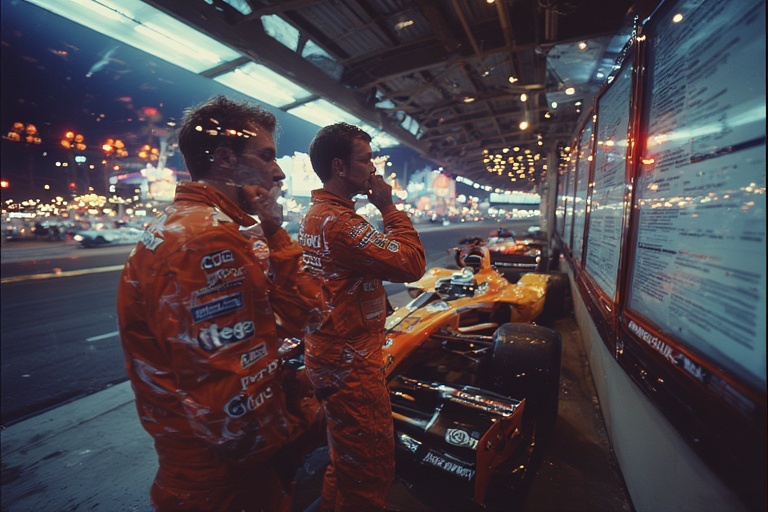
There’s a special kind of silence that can only exist in the middle of a roaring, chaotic Formula 1 paddock. It’s not a true silence, of course. The air is still thick with the shriek of compressed air guns, the low hum of generators, and the distant echo of a hundred thousand cheering fans. No, this silence is internal. It’s the sound of a team’s heart dropping into its collective stomach. For McLaren, that silence arrived not during the glitzy, high-speed chaos of the Las Vegas Grand Prix itself, but in the tense, paperwork-filled hours that followed.
"You work for months, you survive the race, and then the real battle begins in the stewards' office. It's a gut punch that never gets easier."
The story of their weekend wasn't written in the dazzling lights of the Strip, but in the cold, hard language of the FIA technical regulations. Both Lando Norris and his teammate, the unflappable Oscar Piastri, had driven their hearts out. They had navigated the treacherous street circuit, battled rivals, and brought their cars home in what seemed like a solid, points-scoring position. The champagne might not have been sprayed from the top step, but it was a result to build on. Then, the news broke. A post-race scrutineering check had found a technical infringement on both cars. The outcome was as brutal as it was final: disqualification. In the blink of an eye, a hard-fought achievement was wiped from the record books.
The Anatomy of a Crisis: When the Floor Falls Out
While the public announcement sent shockwaves through the F1 world, the initial tremor was felt hours earlier within the McLaren garage. The process is methodical and nerve-wracking. After the race, the FIA technical delegates select random cars for deep inspection. When the call came for both McLarens, a low-level concern began to simmer. That concern quickly boiled over into full-blown alarm.
The issue, as reported, centered on a component of the car's floor assembly. In the high-speed, low-downforce configuration required for the long Las Vegas straights, the skid blocks—designed to prevent the cars from running too low to the ground—had worn beyond the permitted tolerance. It’s a microscopic margin, a matter of mere millimeters, but in Formula 1, a millimeter is a chasm. The rules are black and white. Exceed the wear limit, and the car is deemed to have run illegally low, gaining an aerodynamic advantage. The team’s protests that it was a matter of extreme track wear and not a deliberate design flaw fell on the deaf ears of a regulation book that offers little room for interpretation. It was a catastrophic failure of their pre-race simulations and a brutal lesson in the unforgiving nature of the sport's technical laws.
The Team Principal's Agony: Managing the Human Fallout
For Team Principal Andrea Stella, the moment was a test of leadership under the most public and painful of circumstances. His immediate task was twofold: manage the formal appeal process with the FIA and, more importantly, manage the morale of his team and two devastated drivers.
Imagine the scene in the motorhome. Two exhausted drivers, still in their race suits, having just debriefed on a race that no longer exists. Hundreds of mechanics, engineers, and strategists who had poured their souls into the weekend, seeing their work nullified by a single, critical measurement. The initial emotion is raw disappointment, often tipping into anger and frustration. Stella’s role was to be the anchor. He had to validate their hard work while also accepting the stark reality of the ruling. The public statement would be measured and respectful of the FIA's process, but internally, the message was clear: We mourn this, we learn from it, and we move forward. Together. This is where a team is truly built—not in the glory of a podium, but in the shared pain of a collective setback.
A Scientific Parallel: The Butterfly Effect in a Carbon Fibre World
This kind of incident is a perfect illustration of the "Butterfly Effect" in elite sport. A seemingly minor miscalculation—a predicted wear rate for a specific component on a newly resurfaced track—snowballs into a result-altering catastrophe. It’s akin to a NASA engineering team discovering a tiny, miscalculated tolerance in a heat shield tile; the spacecraft might have functioned perfectly for 99.9% of the mission, but that 0.1% flaw is fatal.
In McLaren's case, the "flaw" was likely a complex interplay of factors. The unique, abrasive surface of the Las Vegas track, the incredibly high straight-line speeds, and the specific setup choices all conspired to wear down that critical component just a fraction more than anyone had predicted. The team's simulations, incredibly sophisticated as they are, are still just models of reality. Las Vegas provided a brutal, real-world data point that their model had missed. The learning from this will be incorporated into their systems, making their predictions for future street circuits more robust. It was a painful, public, and expensive experiment, but an experiment nonetheless.
| Stage | What Happens | Team Mindset |
|---|---|---|
| The Race | Cars perform to plan, drivers push to the limit, team executes strategy. | Focused, competitive, hopeful. |
| Post-Race Scrutineering | FIA technical delegates perform detailed physical inspections of selected cars. | Apprehensive, watchful. |
| The Non-Compliance Discovery | A component is found to be outside the strict legal tolerances defined in the regulations. | Alarm, initial disbelief, frantic internal checks. |
| The Stewards' Hearing | The team presents its case; the stewards deliberate based solely on the written regulations. | Defensive, anxious, preparing for the worst. |
| The Verdict | Official disqualification is announced, results are amended. | Devastation, public acceptance, private frustration. |
The Road Ahead: Scars and Lessons
For Norris and Piastri, the experience is a rite of passage. Every great driver has a "what if" or a "we were robbed" story in their career. This one will sting, but it also forges a thicker skin. They saw their on-track efforts erased by an off-track technicality, a harsh reminder that Formula 1 is a team sport in the truest sense—the driver's performance is the tip of a gigantic, complex iceberg.
The true measure of McLaren's character won't be this disqualification, but how they respond in the next race. Do the mechanics work with an even fiercer determination? Do the engineers double-check every calculation? Does the leadership foster a culture of relentless attention to detail without breeding a culture of fear? The lost points are a heavy blow in the Constructors' Championship, but the gained resolve could be far more valuable. In the high-stakes world of F1, a team isn't defined by its failures, but by its response to them. And for McLaren, the response begins now.