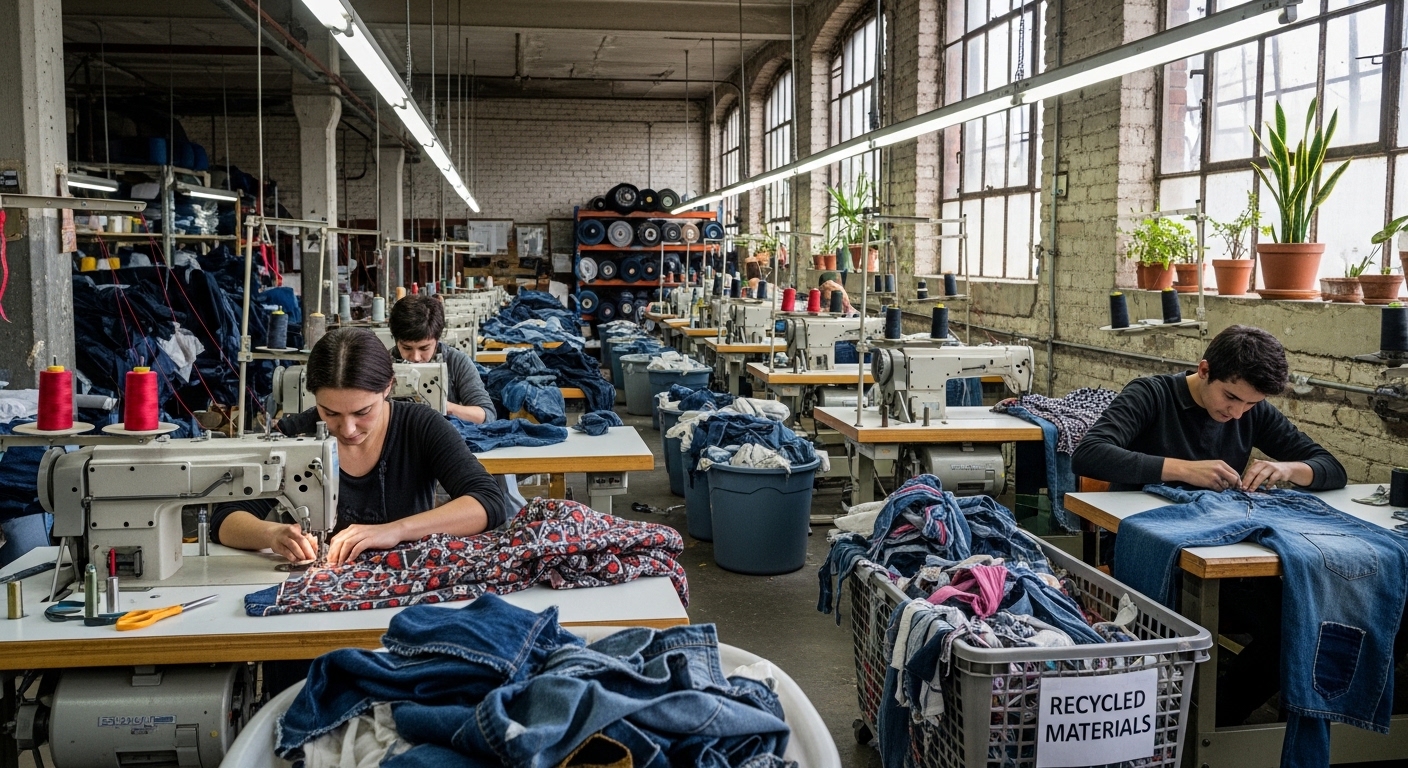
A major new report has sounded an alarm on the UK fashion industry's ability to transition toward a circular economy, warning that a general decline in technical education and a fragmented approach to professional development are undermining sustainability efforts. The findings highlight a critical vulnerability in the industry's sustainability ambitions: without skilled workers to repair, remake, and recycle garments, circular fashion remains an aspiration rather than a reality.
The report, released by an industry coalition, comes as brands across the UK face mounting pressure to meet sustainability targets and comply with evolving regulations. But the research suggests that even with investment in circular infrastructure, the lack of trained professionals capable of executing circular processes could stall progress.
"A general decline in technical education and a fragmented approach to professional development are undermining the UK's shift toward a circular fashion economy." — Major new industry report
What the Report Found
The report identifies two interconnected problems threatening the circular transition:
Declining technical education: Over the past two decades, the UK has seen a steady erosion of technical and vocational training in textiles and garment construction. School-level design and technology programs have been cut, further education colleges have reduced textile-focused courses, and apprenticeships in garment-making have become increasingly rare. This decline has created a generation of fashion graduates with strong conceptual skills but limited practical knowledge of garment construction, repair, and deconstruction.
Fragmented professional development: For workers already in the industry, the report found no coherent system for upskilling in circular economy practices. Training opportunities are inconsistent, often brand-specific rather than industry-wide, and rarely accessible to workers across the supply chain. This fragmentation means that even as companies invest in circular infrastructure, the workforce needed to operate it is unevenly distributed and inconsistently trained.
The combination, the report warns, creates a structural barrier to circularity that cannot be solved by technology or investment alone.
Why Skills Matter for Circular Fashion
Circular fashion depends on a set of technical skills that differ significantly from those used in linear production models. Where conventional fashion focuses on efficient manufacturing of new garments, circular models require:
- Repair and mending: Extending garment life requires workers skilled in visible mending, invisible repair, and structural alterations that maintain garment integrity
- Remanufacturing: Transforming used garments into new products requires understanding of deconstruction, pattern adaptation, and reconstruction techniques
- Textile sorting: Circular systems depend on accurate sorting of used textiles by fiber composition, quality, and recyclability—skills that combine technical knowledge with hands-on assessment
- Recycling operations: Mechanical and chemical recycling facilities require operators who understand fiber behavior, material blends, and processing parameters
- Design for circularity: Even at the design stage, creating garments intended for circular end-of-life requires knowledge of material compatibility, disassembly-friendly construction, and recycling processes
Without workers trained in these areas, the report argues, circular initiatives risk being designed around theoretical models rather than practical realities.
Industry Consequences
The skills gap has already begun to manifest in concrete industry challenges:
Extended Producer Responsibility (EPR) compliance: The UK is moving toward EPR schemes that hold brands responsible for the end-of-life management of their products. Meeting these obligations will require significant expansion of collection, sorting, and processing capacity—all of which depend on skilled workers. Without adequate workforce development, the report warns, EPR could become an unfunded mandate that brands cannot practically fulfill.
Repair services and warranty programs: As brands launch repair programs and extended warranties to demonstrate circular commitment, they face shortages of qualified repair technicians. Several major retailers have reportedly struggled to scale repair services due to lack of available skilled workers.
Textile recycling infrastructure: Planned investments in UK textile recycling facilities depend on a workforce capable of operating sorting and processing equipment. The report notes that several announced recycling facilities have faced delays in staffing, with operators reporting difficulty finding workers with relevant technical backgrounds.
Consumer trust: When circular services are launched with under-trained staff, poor quality outcomes can damage consumer confidence in circular models. A single poor repair experience can discourage consumers from choosing repair over replacement, undermining the behavioral shifts circular models require.
Root Causes: The Decline of Technical Education
The report traces the skills gap to long-term trends in UK education policy. Since the 1990s, technical and vocational education has been deprioritized in favor of academic pathways. Design and technology programs in secondary schools have seen curriculum hours reduced, and many schools have closed textile workshops due to funding pressures.
Further education colleges have also reduced textile and fashion programs, with some of the UK's most respected fashion courses reporting decreased applications for technical pathways. The closure of the London College of Fashion's technical workshops during restructuring was cited in the report as symptomatic of broader trends.
Apprenticeships, historically a key pathway into garment trades, have declined dramatically. The report notes that in 1990, the UK had an estimated 50,000 skilled garment workers; today, that number has fallen to fewer than 5,000, with most nearing retirement age.
The result is a workforce where conceptual fashion education has expanded while technical training has contracted—a mismatch for an industry increasingly reliant on hands-on circular processes.
Fragmented Upskilling: No System, No Standards
For workers already in the industry, the report found no coherent framework for acquiring circular economy skills. Training initiatives, where they exist, are typically launched by individual brands for their own supply chains, creating uneven capabilities and limited mobility for workers.
Several challenges emerged in the research:
No standardized training: Unlike certifications for conventional manufacturing skills, there is no recognized industry standard for circular fashion competencies. Workers trained by one brand may find their skills not recognized elsewhere.
Limited accessibility: Most upskilling opportunities are concentrated in London and other major cities, leaving workers in manufacturing regions with fewer options.
Inconsistent quality: The report found wide variation in the quality and content of circular economy training, with some programs focused on high-level concepts while others provide hands-on technical instruction.
No career pathways: Even when workers acquire circular skills, there is often no clear career progression. Circular roles remain marginal in many organizations, making it difficult for workers to build long-term careers in the field.
What the Report Recommends
To address the skills gap, the report outlines a series of recommendations for industry, government, and education institutions:
Invest in technical education: Reintroduce textile and garment construction programs in secondary schools and further education colleges, with funding for workshop facilities and qualified instructors.
Create apprenticeships: Develop new apprenticeship standards for garment repair, textile sorting, and circular manufacturing, creating entry pathways into the industry.
Establish industry-wide training standards: Develop recognized certifications for circular fashion skills that allow workers to transfer between employers and build career pathways.
Fund accessible upskilling: Create government-funded programs that provide circular skills training to workers across the industry, with particular focus on manufacturing regions.
Integrate skills into circular policy: Ensure that government circular economy policies include workforce development components, not just infrastructure investment.
Support knowledge transfer: Develop programs that capture skills from retiring garment workers and transfer them to new entrants, preserving knowledge that would otherwise be lost.
Industry Response and Initiatives
Some industry groups have begun to respond to the skills challenge. The UK Fashion & Textile Association has launched a circular skills working group, and several major retailers have partnered with further education colleges to develop repair training programs. The report notes these initiatives as positive but emphasizes that current efforts remain fragmented and underfunded relative to the scale of the challenge.
Several European countries were cited as potential models. Italy, for example, maintains a robust system of technical textile education through its network of "Istituti Tecnici," while France has integrated circular economy skills into its national fashion education framework. The report suggests the UK could learn from these approaches while developing its own context-specific solutions.
Looking Ahead: Circular Economy Without Circular Skills
The report concludes with a stark warning: circular fashion infrastructure without a skilled workforce will not deliver circular outcomes. Machines and facilities can be purchased, but the knowledge to operate them effectively cannot be acquired overnight.
As the UK fashion industry faces growing pressure to demonstrate circular progress—from regulators, investors, and consumers—the skills gap represents a structural vulnerability that cannot be addressed through technology or investment alone. The report calls for urgent action across education, industry, and government to ensure that the workforce needed for circular fashion is developed alongside the infrastructure.
"We are building the factories but not training the people to work in them," one industry source told the report researchers. "Circular fashion will fail if we don't treat skills as infrastructure, not an afterthought."
The report's release comes as the UK government considers new circular economy legislation and as brands prepare for extended producer responsibility requirements. Whether those policies include workforce development components—and whether industry can mobilize to train the next generation of circular fashion workers—may determine whether the UK's circular transition moves from ambition to achievement.