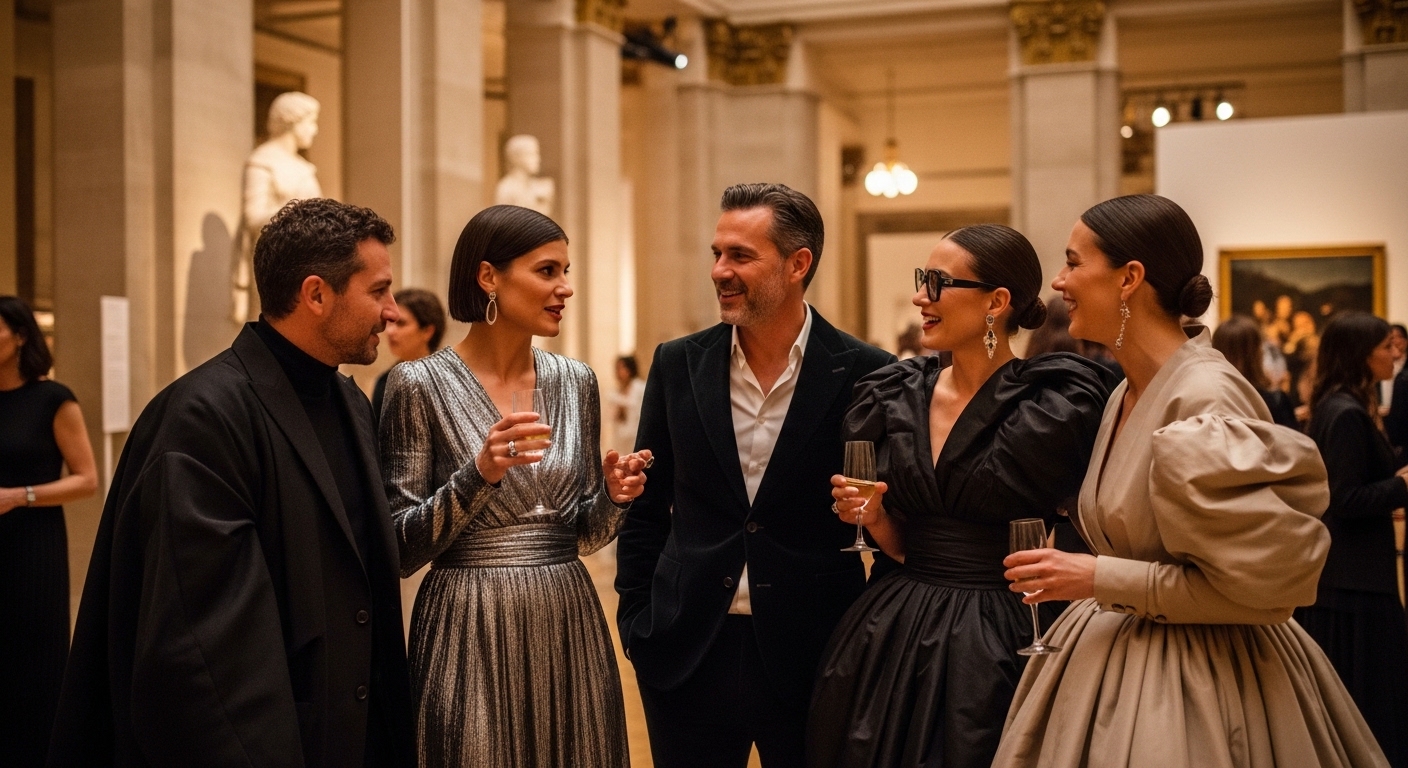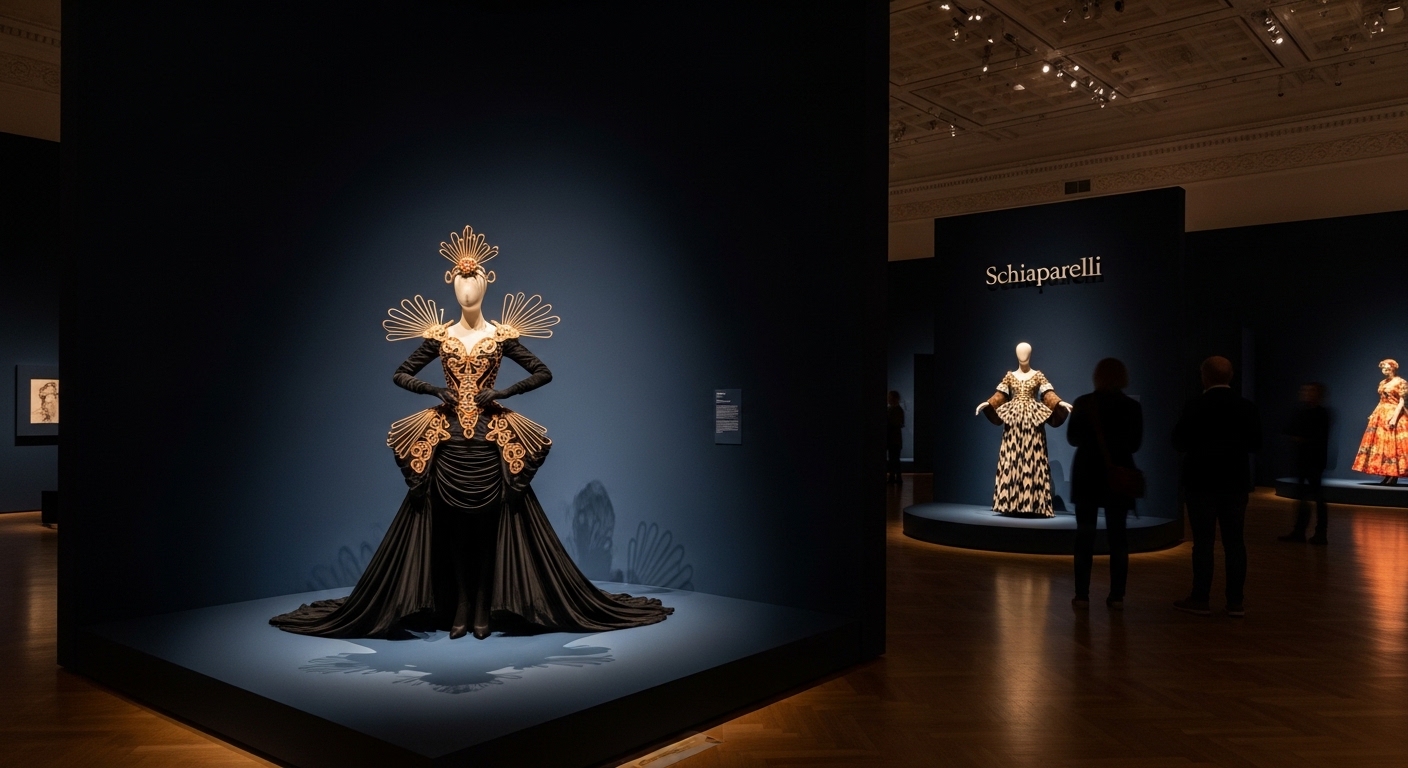
A landmark exhibition on the avant-garde fashion house Schiaparelli has opened at London's Victoria and Albert Museum, bringing together more than 400 objects that trace the maison's century-long dialogue with art. "Schiaparelli: Fashion Becomes Art" is the first UK exhibition dedicated to the house founded by Elsa Schiaparelli in 1927, known for interpreting the interwar surrealist movement through cloth.
Among the treasures on display are some of the Parisian fashion house's most celebrated yet rarely seen pieces, including the only surviving Skeleton dress designed by Schiaparelli and artist Salvador Dalí in 1938. V&A senior curator of fashion Sonnet Stanfill curated the exhibition to challenge common misconceptions about Schiaparelli's creative role.
"I think there could be a misconception that she simply took surrealist motifs and stuck them on her clothes, when in fact, she was an active collaborative partner in the design process." — Sonnet Stanfill, V&A senior curator of fashion
Stanfill explains that Schiaparelli's clothes "were an expression of a surrealist aesthetic that reflected her role as an active protagonist in the surrealist movement." Contemporary accounts described her Paris couture salon as "the beating heart of the surrealist movement."
Here are five key pieces to look out for in the exhibition, as highlighted by curator Sonnet Stanfill.
Evening Suit by Elsa Schiaparelli, Autumn 1937
This suit represents Schiaparelli's deep engagement with historical fashion and her commitment to exceptional craftsmanship. From the Autumn 1937 season, the jacket features intricate embroidery around the collar and down the center front—a nod to the habit à la française, the most formal and luxurious men's attire of the late eighteenth century.
The complex surface decoration demonstrates the highly skilled embroidery executed for Schiaparelli by the specialist firm Lesage, one of Paris's most prestigious embroidery ateliers. The suit was worn by Lady Alexandra Haig, who chose to wear it for a portrait published in society magazine The Tatler in January 1938. The piece exemplifies Schiaparelli's ability to blend historical reference with modernist sensibility, creating garments that appealed to sophisticated clients who valued both artistry and social currency.
Shocking Perfume Bottle by Leonor Fini, 1937
Schiaparelli's most famous perfume, Shocking, was housed in a bottle designed by her friend, the artist Leonor Fini. The bottle's shape was modeled on the dress form of actress Mae West, then present in Schiaparelli's atelier, and featured a measuring tape wrapped around the shoulders—a characteristic Schiaparelli touch that merged fashion functionality with surrealist whimsy.
Fini, whose surrealist artworks often referenced clothing, was reportedly disappointed by the addition of small flowers to her design by Schiaparelli's commercial director. The perfume's name was equally provocative: "Shocking" referenced both the vibrant pink color—Schiaparelli's signature "shocking pink"—and the sensation the designer aimed to create in the fashion world. The bottle remains one of the most recognizable perfume containers in fashion history and represents Schiaparelli's skill at branding and marketing long before such concepts were formalized.
Skeleton Dress by Elsa Schiaparelli and Salvador Dalí, Summer 1938
This is the first Elsa Schiaparelli dress visitors encounter in the exhibition, and its placement is intentional. The Skeleton dress represents the pinnacle of Schiaparelli's collaboration with Salvador Dalí and is the only known surviving original of this design.
Together, Schiaparelli and Dalí brought a skeleton to life using the trapunto quilting technique, stitching the outline through two layers of fabric with wadding. The sheer black material, combined with the padded spine, ribcage, collarbones, and hip joints, creates the illusion that we are seeing the wearer's own flesh and bones beneath the fabric.
The dress was created during a period of intense creative exchange between Schiaparelli and the surrealist movement. Dalí had previously worked with Schiaparelli on other designs, including the Lobster dress and the Shoe hat. The Skeleton dress demonstrates how their collaboration went beyond simply applying artistic motifs to clothing—it involved reimagining the very structure of garments to create wearable surrealist statements.
Lobster Telephone by Salvador Dalí, 1938
While not a garment, this object appears in the exhibition to illustrate the free flow of ideas between Schiaparelli, Dalí, and their circle. Lobsters were a prevailing motif for Dalí, who considered them sexually charged. For Schiaparelli beachwear, he drew a lobster among parsley, which was transferred to silk by designer Paul Sache.
For Schiaparelli's Summer 1937 collection, Dalí proposed applying the design to a simple high-waisted dinner dress, suggestively positioning the creature on the skirt. When poet Edward James commissioned Dalí to make the Lobster Telephone in 1938, it reflected the collaborative environment where ideas moved fluidly between artists, designers, and writers.
The exhibition places more than 50 pieces of art alongside approximately 100 Schiaparelli garments, visualizing the creative dialogue that defined the house. The Lobster Telephone sits as a reminder that Schiaparelli's work was not simply inspired by surrealism but was embedded within the movement itself.
Custom Gown for Ariana Grande by Daniel Roseberry, 2025
The exhibition extends Schiaparelli's story to the present day through this gown created for Ariana Grande at the 2025 Oscars. Nominated for Best Supporting Actress for her role in "Wicked," Grande wore this glittering custom Schiaparelli creation designed by current creative director Daniel Roseberry.
The gown features a heel at the back that pays homage to Dorothy's ruby slippers from the original 1939 film "The Wizard of Oz"—a fitting reference given Grande's role in the musical adaptation. It also alludes to Elsa Schiaparelli's Shoe hat, created in collaboration with Salvador Dalí in 1937, creating a through-line from the house's surrealist origins to its contemporary Hollywood presence.
Stanfill notes that Daniel Roseberry, who has led the fashion house since 2019, shares Schiaparelli's talent for capturing public attention. "Daniel Roseberry has captured the imagination of the social media world," she said. Through pieces such as his trompe l'oeil and faux taxidermy gowns, the American designer has brought a new generation of famous fans to the label—from Bella Hadid to the Kardashians—who epitomize the social media generation.
"Schiaparelli is celebrating its 100th anniversary next year, and across the century, there is this incredible shared skill at communicating the creative process to a wide audience. They may not even be clients or particularly knowledgeable about fashion. But I think one doesn't have to be, to understand it." — Sonnet Stanfill
Beyond the Blockbusters: What Else the Exhibition Reveals
While these five pieces represent some of the exhibition's highlights, Stanfill emphasizes that she wanted to go beyond Schiaparelli's famous collaborations to highlight lesser-known aspects of her work. These include her unexpected focus on practicality, her pieces for private clients at the house's historic London branch in Mayfair, and her leading work for stage and screen.
"Her most remembered garments, because they're the most notable and visually shocking in some ways, are her collaborations with Dalí and with Jean Cocteau," Stanfill explained. "But I hope that that's not all she'll be remembered for in history books, and that's something that we work really hard to show, is that there's so much else aside from the surrealist collaborations."
Schiaparelli's work for theater and film demonstrates her ability to capture what we would now call the "attention economy." As Stanfill notes, a successful West End production in the 1930s could reach a quarter of a million people, with costume credits serving as a form of advertising equivalent to a modern Instagram account. This talent for reaching wide audiences, she suggests, is mirrored in Roseberry's success with today's social media landscape.
Exhibition Design and Visitor Experience
The exhibition design by London studio Nebbia enhances the surrealist experience by guiding visitors to double back on themselves several times throughout the show. This intentional layout allows viewers to see the same object from different perspectives and creates a feeling of déjà vu—a nod to surrealist preoccupations with dreams and altered perception.
"Schiaparelli: Fashion Becomes Art" runs at the V&A from March 28 to November 1, 2026. With more than 400 objects on display, including garments, artworks, and archival materials, the exhibition offers the most comprehensive exploration of the house's history ever staged in the UK. For fashion enthusiasts, surrealist art admirers, and anyone interested in the intersection of creativity and commerce, it represents a rare opportunity to see these iconic pieces in dialogue with the art that inspired them—and the artists who inspired Schiaparelli in return.